Five Contracts, One River
Low water on the Rhine is exposing how much industrial redundancy exists only on paper — from German chemical plants to gold mines on the other side of the world.

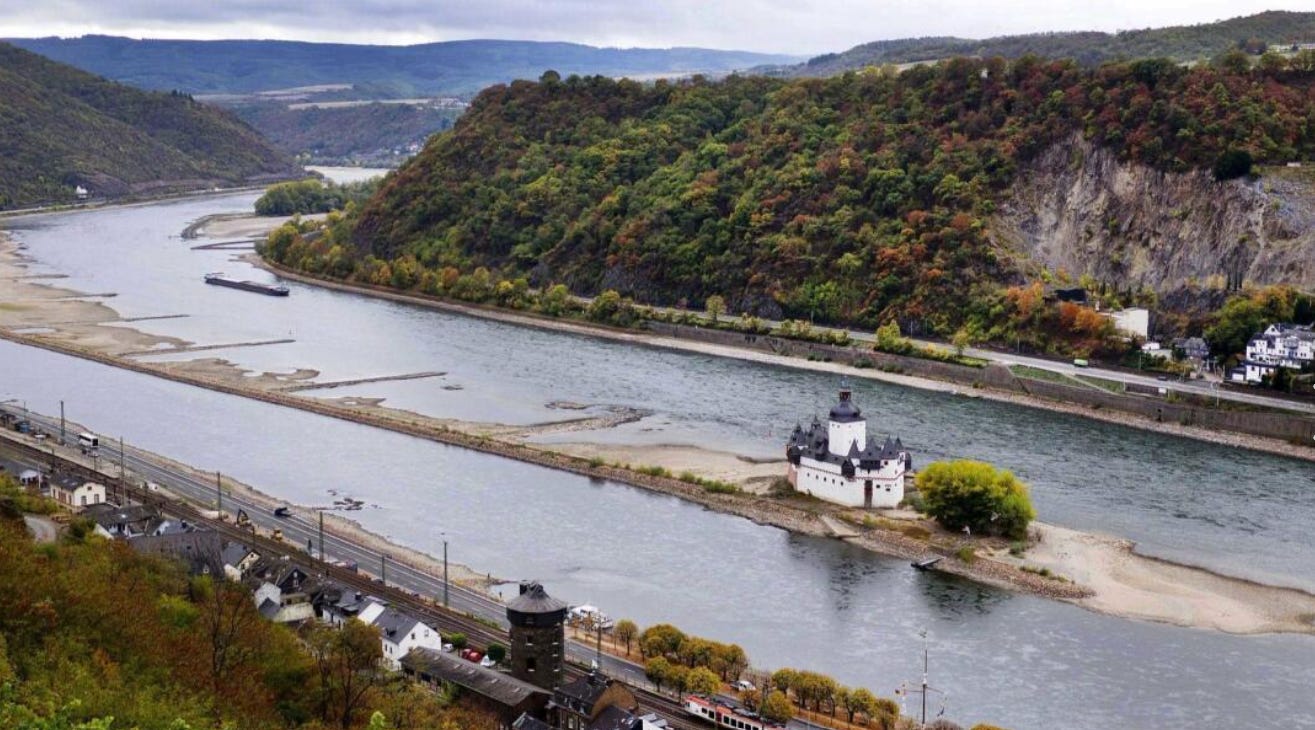
In August 2026, exceptionally low water has pushed the Rhine to record lows around Kaub, the narrow, shallow section of the river between the great industrial systems of northern and southern Germany. Commercial barge traffic has become severely restricted, some sailings have stopped altogether, and freight is being pushed onto roads and railways that can’t come close to replacing the river’s carrying capacity. German shippers have warned that if navigation fails at Kaub, the Rhine is effectively split into two transport systems: the northern river remains connected to Rotterdam, Antwerp and Amsterdam, while the Upper Rhine industrial basin to the south loses its continuous river connection to the North Sea ports. (Reuters)
The Rhine is also the bloodstream of Europe’s largest integrated chemical manufacturing system, a chemical production commons unlike anything else in Europe. Along it sit BASF’s enormous Ludwigshafen complex, Covestro, Evonik, Bayer, LyondellBasell, LANXESS, INEOS and dozens of other chemical, refining, steel and manufacturing sites. They’re connected by physical flows of naphtha, gases, acids, solvents, intermediates, fuels, cooling water and finished chemicals.
As the Super El Niño roars to life on European river systems during 2026, we will have to wait and see how low the river will go.
The first signs of production stress are being announced to stakeholders. Covestro has declared force majeure on polyether polyols at Dormagen because transport capacity lost on the Rhine couldn’t be fully replaced by road and rail. BASF has declared force majeure on DINP and DPHP plasticisers at Ludwigshafen, citing extreme weather and significant Rhine logistics constraints, and later declared force majeure on several European surfactants following disrupted raw-material deliveries. LyondellBasell declared force majeure on butadiene from its Wesseling unit after low Rhine levels restricted feedstock deliveries. Market participants also reported that LANXESS declared force majeure on phthalic anhydride at Uerdingen, although the company hadn’t publicly confirmed that declaration when it was reported. Evonik has acknowledged production constraints at Marl. (Reuters)
A transport failure is turning into a chemical supply-chain failure.
In several branches of the chemical system, it already has. The real question is how bad will it get during the rest of 2026 moving into 2027.
The Rhine isn’t just a river
Modern economies are usually described through a financial ledger. We talk about markets, prices, companies, GDP, trade and investment. But underneath that financial economy sits a physical ledger.
A tyre requires rubber. Rubber requires butadiene. Butadiene is extracted from streams produced by steam crackers, and steam crackers require hydrocarbon feedstocks such as naphtha. The naphtha has to physically reach the cracker. The cracker needs electricity, steam, and cooling water, and it needs somewhere to send every product and co-product it makes. If one of those flows disappears, money can’t simply vote another one into existence.
This is why the Rhine matters both as a transport corridor and as the artery running through Germany’s chemical production commons.
BASF has previously disclosed that under normal conditions around 40 per cent of incoming volumes at Ludwigshafen arrive by ship. During the severe low-water crisis of 2018, river deliveries became almost impossible for long periods. BASF reduced plant utilisation, and the company later estimated that the low Rhine reduced its 2018 earnings by around €250 million. BASF also reported that restricted raw-material supply and insufficient cooling-water availability were simultaneously constraining production. (BASF)
That experience demonstrated that a giant chemical complex is both a collection of individual factories and an integrated chemical-production ecosystem.
BASF calls Ludwigshafen a Verbund, an integrated production network in which the output of one plant becomes the input of another.
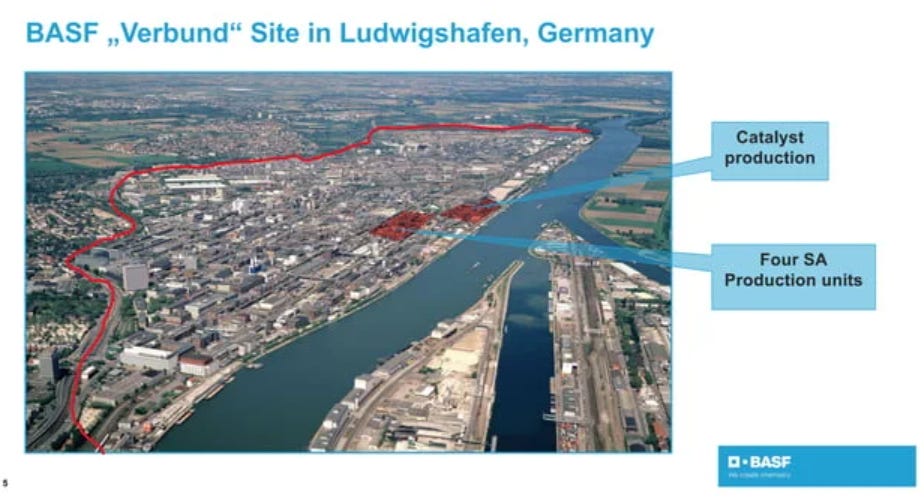
Heat from one process can provide energy for another. Hydrogen, chlorine, steam and intermediate chemicals move between units. Co-products that might otherwise be waste become feedstocks elsewhere.
This integration produces extraordinary efficiency when everything works, but it also means a plant doesn’t have to run out of its own principal raw material in order to stop.
It can stop because another plant has run out of its raw material, because a co-product can’t be removed, because a storage tank is full, because a customer downstream has stopped taking an intermediate, because there isn’t enough cooling water, or because a chemical normally delivered continuously by barge or pipeline has disappeared.
Failure can therefore travel through the complex in directions that are difficult to predict. This is why force majeure isn't just legal notices to customers and stakeholders; it’s also a red flag showing where the physical network is beginning to strain. One force majeure can be an isolated problem. A cluster of them across related parts of the chemical system is something else entirely.
Follow the naphtha
One of the most important chains begins with naphtha, a principal feedstock for European steam crackers.
Inside a cracker, hydrocarbons are heated to extraordinary temperatures and broken into smaller molecules. Out comes a family of chemicals including ethylene, propylene, crude C4 streams containing butadiene precursors, hydrogen and aromatic-rich products. You don’t have to learn all their names. The important point is that they sit near the roots of an enormous number of downstream industrial processes.
Consider ethylene. From ethylene come polyethylene plastics, ethylene oxide, ethylene glycol, ethanolamines, surfactants and numerous chemical intermediates. Ethylene glycol eventually appears in polyester fibres, PET packaging, antifreeze and industrial fluids.
Propylene feeds polypropylene, propylene oxide, acrylic acid, acrylates, acrylonitrile and numerous other products. Propylene oxide feeds polyether polyols, which react with isocyanates to make polyurethane. Polyurethane becomes insulation, mattresses, car seats, refrigerators, adhesives, coatings, sealants and countless engineered components.
Then there’s butadiene. Butadiene feeds synthetic rubber. Synthetic rubber feeds tyres, hoses, belts, seals and vibration-control systems. Butadiene also feeds ABS and other polymers used in vehicles, appliances, electronics and industrial equipment.
So a disruption that begins with the inability to move enough hydrocarbon feedstock along a river can travel surprisingly quickly:
low Rhine water → less feedstock reaching crackers → lower cracker utilisation → less ethylene, propylene and crude C4 → less butadiene, ethylene oxide and propylene oxide → less rubber, polyols, surfactants and polymers → pressure on tyres, cars, insulation, furniture, coatings, electronics and construction materials.
The wheels start falling off the entire system.
Conceptually this isn’t especially complicated. It isn’t much more complicated than cooking from a recipe, except the ingredients have longer names and the recipe book contains much of modern industrial civilisation. If you don’t have an essential ingredient, the product doesn’t get made.
We’ve already seen what happens when the same feedstock problem occurs elsewhere. Earlier in 2026, disruption through the Strait of Hormuz threatened roughly 4 million tonnes of Middle Eastern naphtha moving to Asia each month. Asian crackers cut operating rates, shut units, cancelled tenders, and force majeure declarations spread through petrochemical markets. That’s roughly 48 million tonnes a year of naphtha flow exposed if monthly volumes are annualised, which gives some idea of the scale of the system we’re talking about. (Reuters)
The global chemical industry has therefore already run part of this experiment. When naphtha supply becomes unreliable, crackers really do reduce operating rates. When crackers reduce rates, basic olefin availability tightens. And when those molecules become scarce, disruption can propagate into derivatives. The same basic mechanism is now being reported in Germany’s petrochemical cluster.
That’s the mechanism through which a physical chemical shortage can become supply-side inflation. It doesn’t mean every disrupted chemical automatically produces economy-wide inflation. Inventories, substitution, weak demand and producer margins can absorb some of the shock. But it explains how shortages in a relatively small number of upstream molecules can spread costs into industries that appear to have little connection to the original problem.
Watch where force majeure appears
The most important warning isn’t simply the number of companies reporting force majeure. It’s where in the chemical tree the problems are appearing.
If a producer can’t deliver one highly specialised coating additive because a truck is late, the wider economic consequences may be limited. If a producer loses ethylene, propylene, chlorine, ammonia, butadiene or another major upstream chemical, the number of possible downstream consequences becomes much larger. The closer the disruption moves toward the trunk of the chemical tree, the more seriously it should be treated.
We’re already seeing several different branches under pressure. Covestro’s force majeure on Dormagen polyether polyols is directly linked to transport problems. LyondellBasell’s Wesseling butadiene declaration is more significant because butadiene sits farther upstream and feeds large synthetic-rubber and polymer chains. BASF’s plasticiser and surfactant declarations show the failure spreading through different derivative systems, while the reported LANXESS phthalic-anhydride force majeure adds another branch. (Reuters)
Evonik’s Marl operations have also been hampered by reduced cargo flows. Among the products made there are C4-derived chemicals including isononanol, an important feedstock for plasticisers such as DINP. Evonik itself identifies automotive products, flooring, wires, cables and construction as downstream uses of this chemistry. Reports in China have also described concern among manufacturers over disrupted supply of Evonik IPDI, another specialised chemical used in polyurethane coatings, adhesives and related applications. (C4 Chemicals)
This is precisely the kind of mechanism seen during the Rhine crisis of 2018. BASF couldn’t simply order more trucks. The quantities involved were too large. The company subsequently confirmed that restricted raw-material supply forced production limitations. (BASF Report 2025)
There’s an important distinction here between commercial redundancy and physical redundancy. A company may have several suppliers on paper, but if all those suppliers rely on the same river, port, railway, pipeline, precursor or chemical complex, the apparent diversification is partly fictional.
Five suppliers using one physical bottleneck aren’t five independent supply chains. They’re five contracts sitting on top of one supply chain.
We’ve seen versions of this elsewhere. Canada can have large quantities of sulphuric acid physically available and still can’t get the acid to where it’s needed because storage, loading, railcars, and transport infrastructure don’t exist at the necessary scale. Having the material somewhere in the economy isn’t the same thing as having a functioning supply chain.
Follow the molecule to the factory
Much of the Rhine chemical industry sits inside one of the densest manufacturing regions on earth. Around it are plastics converters, cable manufacturers, tyre and rubber producers, foam makers, coating companies, construction-material producers, appliance manufacturers and a huge concentration of automotive production.
The chemical tree and the manufacturing tree have grown up side by side.
Take BASF’s DINP and DPHP plasticisers. BASF describes DPHP as particularly suited to automotive interiors and wire-and-cable formulations, while its broader plasticiser range is used to give flexibility to PVC products such as cable coatings and films. (BASF Chemicals)
When the plasticiser leaves Ludwigshafen it can move into a PVC compounder, then into a cable manufacturer, flooring producer, roofing-membrane producer or automotive-component maker, and only then into the final building, electrical system or vehicle.
Evonik’s Marl chemistry overlaps with much of the same downstream economy. Its isononanol is a precursor for high-performance plasticisers including DINP, and Evonik identifies automotive products, flooring, wires, cables, roofing membranes and construction among the industries served by the resulting materials. (C4 Chemicals)
Now consider butadiene. LyondellBasell’s Wesseling force majeure affects a molecule used to produce synthetic rubbers that eventually become tyres, hoses, gaskets, seals and other engineered components. Butadiene is therefore quite different from a narrow specialty additive. It sits near the root of products used throughout transport and manufacturing. (S&P Global)
Covestro’s Dormagen polyols enter another part of the same physical economy. Covestro says polyether polyols are used to produce polyurethane foams found in mattresses, upholstered furniture and car seats, while rigid polyurethane foam is used in building and refrigeration insulation. Covestro also confirms that its Dormagen polyols are part of this polyurethane chain. (Covestro AG)
LANXESS phthalic anhydride feeds plasticisers, resins and coatings. INEOS styrenic materials feed automotive, electrical, electronics and household applications. Once again, apparently separate chemical chains begin converging on many of the same final industries. (LANXESS)
This is where the industrial geography becomes important. Germany alone remains one of Europe’s largest vehicle-production centres, with around one-fifth of EU car production concentrated there. Across the same broad Rhine, Ruhr, Baden-Württemberg and nearby Central European manufacturing basin sit vehicle plants, component manufacturers, seating specialists, tyre companies, cable makers and thousands of smaller industrial suppliers. (ACEA)
That doesn’t mean a particular tonne of Wesseling butadiene necessarily ends up in a particular Ford, Mercedes or Audi, and there’s no need to claim that it does. Commercial relationships change constantly and customer contracts are often private. The important point is structural. The chemical, conversion and final-manufacturing industries are concentrated inside the same broad physical production basin.
This creates what might be called geographic stacking.
Over decades, efficiency naturally has encouraged successive layers of industry to locate around the same infrastructure and around one another. Chemical plants supply converters. Converters supply component manufacturers. Component manufacturers supply final assemblers. Final assemblers sit near large markets and transport corridors. The arrangement makes enormous economic sense because it reduces distance, inventories and logistics costs.
Industries have been grouping together winsce industry began that isnt unsual .
But the layers also begin sharing the same physical dependencies: the Rhine, the same railways, the same motorways, the same terminals, the same power systems, the same industrial water and often the same upstream chemical complexes.
This means several apparently independent chemical failures can eventually arrive at the same finished product. A vehicle may require synthetic-rubber seals derived from butadiene, polyurethane seat foam made from polyols, flexible PVC containing plasticisers, coatings derived from other intermediates and styrenic plastics in moulded components. None of those chemical chains has to collapse completely. The assembly line only needs one indispensable component to become unavailable.
The tyranny of the smallest missing molecule can therefore travel through a chemical producer, a converter and a Tier supplier before the final manufacturer even knows it has a Rhine problem.
Follow the Rhine south
The same logic applies geographically along the river itself. Ludwigshafen isn’t an isolated chemical island. It sits toward the northern end of an industrial corridor that continues through Karlsruhe and Strasbourg, past the chemical complexes around Chalampé and Mulhouse, and down to Basel.
Kaub matters because it sits between much of that Upper Rhine system and the great North Sea ports. German shippers have warned that extremely low water at Kaub can effectively split the Rhine in two. Shipping can still operate on parts of the river north and south of the bottleneck, but the river stops working as one continuous freight artery. (Reuters)
A river doesn’t have to be dry from Switzerland to Rotterdam before the industrial system loses one of its most useful characteristics. It only needs to become commercially unnavigable at a sufficiently important choke point.
The Upper Rhine contains several enormous industrial nodes.
At Karlsruhe sits MiRO, Germany’s largest refinery. Its crude oil has an important piece of physical redundancy because it arrives from the Mediterranean through the Transalpine Pipeline rather than depending principally on Rhine barges. But the refinery still depends heavily on the surrounding transport system to move what it produces. MiRO says 61 per cent of its finished products leave by road, 25 per cent by Rhine ship, 13 per cent by rail and 1 per cent by pipeline. It also says its refinery supplies roughly 10 million people with fuel and heating oil. (Miro Ka)
That gives us a useful counter-example. A refinery can keep receiving crude while losing part of its ability to move finished product. Solving the inbound supply problem doesn’t automatically solve the outbound logistics problem. Indeed, during the current Rhine disruption, Karlsruhe has acted partly as a relief valve as buyers seek alternatives to river-dependent terminals elsewhere. A functioning node can therefore inherit pressure from failing nodes around it.
Farther south, the Port of Strasbourg stretches roughly 100 kilometres along the Rhine from Marckolsheim to Lauterbourg. It handles around 6 million tonnes a year by river and another roughly 1 million tonnes by rail, connecting French and German industry to the same Rhine freight system. This isn’t simply a German river problem. It’s a European industrial-corridor problem. (Ports de Strasbourg)
Then there’s Chalampé in Alsace. BASF started a new world-scale HMD plant there in 2025, increasing its annual HMD production capacity to 260,000 tonnes. HMD is an important building block for polyamide 6.6, linking the Upper Rhine directly into engineering-plastics and nylon supply chains used across automotive and industrial markets. BASF explicitly paired the Chalampé investment with expanded PA 6.6 production in Freiburg. (BASF)
There’s no credible evidence at present that Chalampé has declared force majeure in the 2026 Rhine event. The point is that the productive capacity exists inside the same river corridor and has experienced Rhine logistics problems during earlier low-water periods. Exposure isn’t the same thing as failure, but exposure matters when you’re mapping how a system could propagate stress. Its partciularly important in a Super El Nino year.
At the southern end sits Basel. The Swiss Rhine ports at Basel-Kleinhüningen, Birsfelden and Muttenz form Switzerland’s national transport hub on the Rotterdam-Basel-Genoa freight corridor. They handle millions of tonnes of goods a year and are an important gateway for Swiss fuel, container and industrial imports. (Port of Switzerland)
So the industrial picture is much larger than Kaub to Ludwigshafen. It’s closer to:
North Sea ports → Kaub bottleneck → Mannheim/Ludwigshafen → Karlsruhe → Strasbourg → Chalampé/Mulhouse → Basel → Switzerland and the Alpine transport system.
And if Kaub breaks route, the factories south of it don’t suddenly disappear. The refinery, refineries, chemcial plants and ports still exists. What disappears is some of the physical connectivity that made the whole system work as one system.
The global picture makes the Rhine more important
If the Rhine crisis were occurring in isolation, Europe could probably buy its way out of a larger part of the problem. Imports could rise. Asian producers could increase exports. American producers could redirect cargoes. Inventories could bridge some of the gap. Prices would rise, but spare capacity elsewhere in the global system could absorb part of the shock.
For much of the last three or four decades, that was a reasonable assumption. A disruption in one region could often be compensated for somewhere else. The system was never frictionless, but international trade and spare production capacity provided a large shock absorber.
The problem is that 2026 has already demonstrated how vulnerable the global petrochemical system can become when disruptions hit the same upstream chain in different regions. Earlier this year, Middle Eastern energy and shipping disruptions produced severe naphtha problems for Asian petrochemical producers. Asian steam crackers cut rates, shut units and declared force majeure because they couldn’t rely on normal Middle Eastern feedstock flows. (Reuters)
The Rhine is now applying similar physical pressure to the European end of the global system only months later. That doesn’t mean the events are identical. It means the assumption that spare production, inventory or logistics capacity will always exist somewhere else becomes less reliable when several producing regions are already under pressure.
Resilience is often calculated company by company while scarcity is experienced system by system.
Inventory isn’t the same as resilience
Modern industrial companies have spent decades reducing inventory. There were good reasons for doing so. Inventory, tanks and warehouses cost money. Stored material ties up working capital. Unused railcars, trucks and barges look inefficient. A beautifully optimised supply chain therefore tries to keep materials moving rather than sitting still.
This thinking became particularly influential in the 1990s. I remember Reengineering the Corporation by Michael Hammer and James Champy being treated as one of the pioneering business books of its time. Their argument around just-in-time inventory was broader than simply keeping less stock. The idea was to redesign processes so uncertainty and unnecessary buffers could be removed rather than merely managed more efficiently.
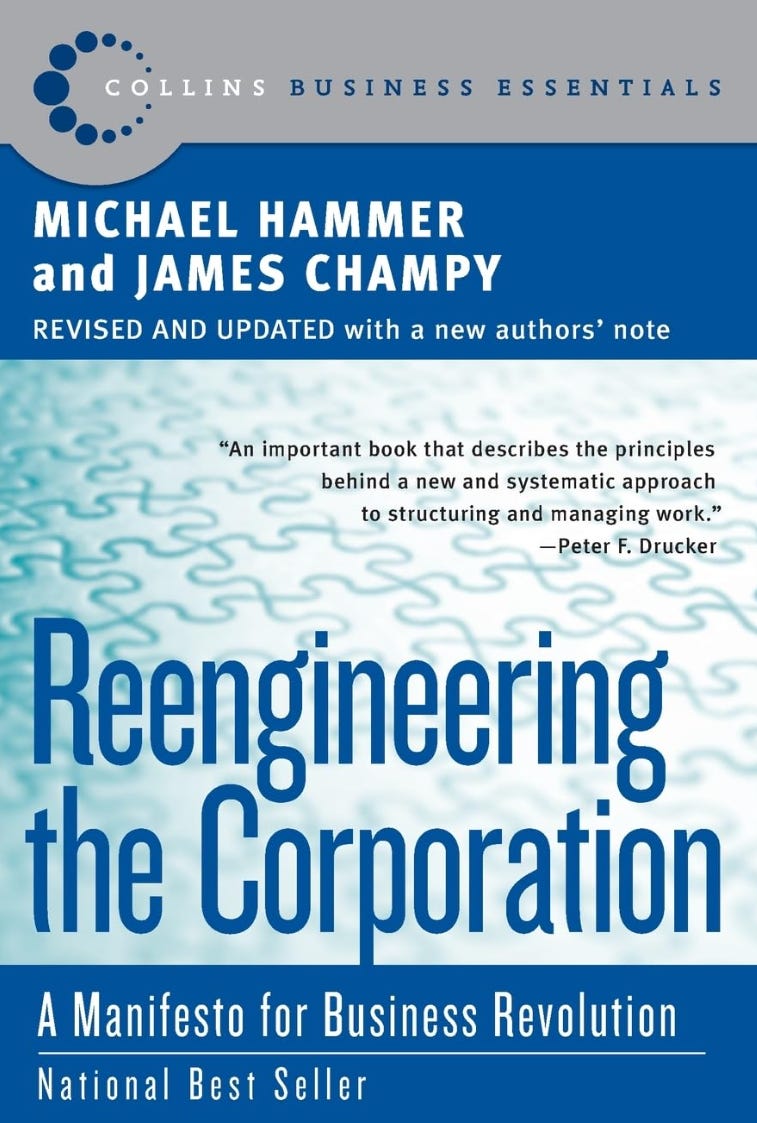
“Many companies claim to be moving to just-in-time inventory, but their reality is still just-in-case inventory. They hold extra stock (and buffers of work, information, cash, or even people) because they are uncertain about when demand will arrive and how much will be needed.
The conventional response is better inventory-management tools. What companies should really do is eliminate the inventory by removing the uncertainty that creates the need for it. Once uncertainty is removed (for example, by structuring processes so suppliers and customers plan and schedule work together), the slack disappears and the inventory is no longer required.”
The difficulty is that under abnormal conditions the same logic creates a hidden trade. Financial efficiency has been purchased partly by reducing time. A factory that once held several weeks of raw material might now hold days. An automotive supplier may operate with only a small line-side buffer. A chemical intermediate may arrive continuously from another plant rather than being held in a large independent tank.
You tune a company like a guitar to the key of efficiency. The system becomes cheaper, but the distance between normal operation and shutdown becomes shorter.
I think of this as temporal leverage.
Financial leverage allows a company to control a large asset base with a relatively small amount of equity. Temporal leverage allows an industrial system to support enormous production with relatively little inventory. Both improve returns while conditions are stable. Both can accelerate failure when conditions change. If you couldn't outline the concepts of Reengineering in the 90s, you couldn't get a senior management role; in those days, the vertical engineering supply chains of the last 200 years were considered obsolete . You had to think “like the 21st century”.

Chemical manufacturing adds another complication because inventory isn’t interchangeable. Having ten thousand tonnes of the wrong chemical doesn’t help if the missing chemical is a catalyst required in kilograms. Having enough ethylene doesn’t help if chlorine is unavailable. Having enough propylene oxide doesn’t help a polyurethane producer if MDI is unavailable.
A production network therefore doesn’t possess resilience equal to the sum of its inventories. Its resilience may instead be determined by its least replaceable necessary input, which is a much harsher constraint.
I remember losing the use of a supercar for 11 months during Covid because I was missing an $85 titanium bolt. Almost the entire car was sitting there. That didn’t make it usable.
The tyranny of the smallest missing molecule
This produces one of the strangest properties of modern manufacturing: economic importance and physical volume are often almost unrelated. A giant factory consuming thousands of tonnes of commodities can be stopped by a chemical or component representing a tiny fraction of its material bill.
A catalyst, curing agent, semiconductor process chemical, specialty extractant, stabiliser, coating resin, qualified pharmaceutical intermediate or a titanium bolt can be worth almost nothing relative to the finished product and still determine whether that product can be made at all.
The downstream manufacturing chains around the Rhine show one version of this dependency because the stages are packed relatively close together geographically. Mining shows the opposite version. A mine can sit thousands of kilometres from Germany and still depend on the same underlying chemical economy.
Modern extraction and refining depend heavily on industrial chemistry. Copper extraction can require sulphuric acid, solvent-extraction reagents, flocculants and antiscalants. Nickel and cobalt refining use acids, alkalis, extractants and precipitation reagents. Lithium conversion may require sulphuric acid, hydrochloric acid, caustic soda and soda ash. Rare-earth separation can require acids, alkalis, organophosphorus extractants and ion-exchange materials. Uranium processing can depend on leaching reagents, oxidants, amine extractants and resins. Battery recycling requires another family of acids, alkalis, oxidants and separation chemicals.
Gold reveals the vulnerability particularly clearly.
A mine can sit thousands of kilometres from the Rhine and appear to have nothing to do with Europe’s chemical industry, yet the gold can’t simply be dug out of the ground and sold. Most modern gold extraction depends on cyanide-based processing, and sodium cyanide is itself the end product of another industrial supply chain.
Hydrogen cyanide must first be manufactured from chemical feedstocks such as ammonia and natural gas before being converted into sodium cyanide using caustic soda. Each of those inputs has its own energy, manufacturing and transport requirements. A disruption therefore doesn’t need to reach the mine itself to affect gold production. It only has to break one sufficiently important link in the chemical chain that makes extraction possible.
The missing $85 bolt has real-world analogues.
Cyanide chemistry has existed at Wesseling, directly on the Rhine south of Cologne, for more than a century. More importantly, the Rhine chemical corridor manufactures several of the fundamental chemicals that underpin mining and mineral-processing supply chains.
Covestro produces caustic soda, chlorine and hydrogen at its Lower Rhine sites. It also produces hydrochloric acid at Leverkusen, Dormagen and Uerdingen and says roughly 30 per cent of the hydrochloric acid manufactured at those locations is delivered to customers via the Rhine. (Covestro AG)
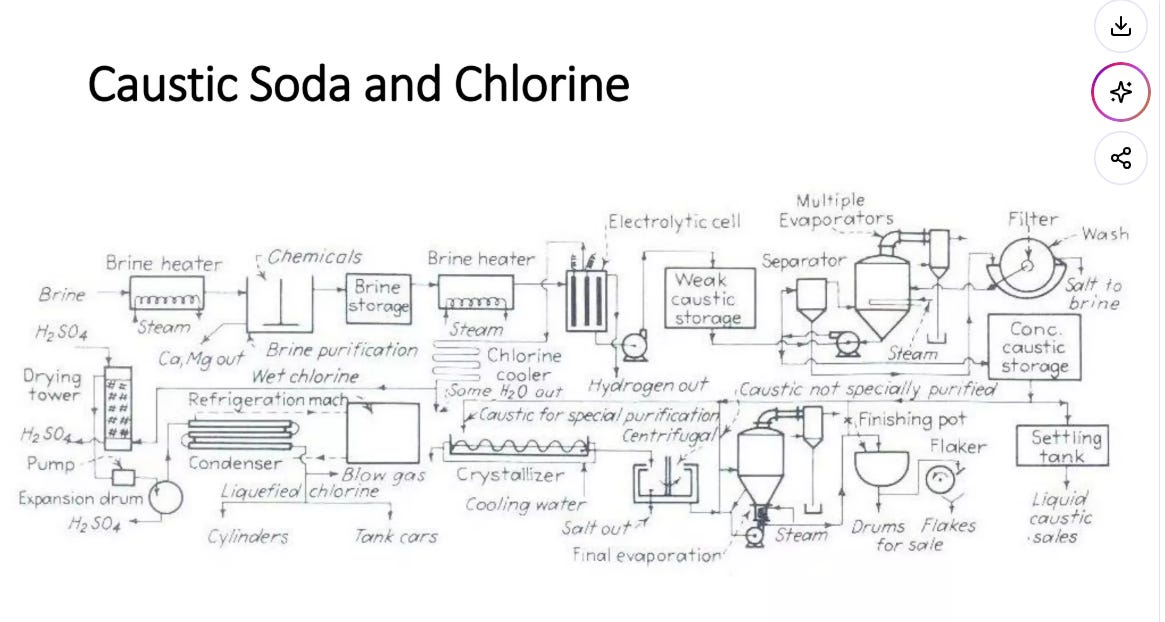
BASF produces large volumes of inorganic and industrial chemicals at Ludwigshafen, including sulphuric acid. Its own product information for 96 per cent technical sulphuric acid from Ludwigshafen is unusually revealing: BASF says that grade is offered only by river-barge shipment. (BASF Chemicals)
Caustic soda is used directly in mineral processing and in sodium-cyanide manufacture. Hydrochloric acid is used in leaching, purification and metals refining. Sulphuric acid is one of the basic working fluids of modern industrial civilisation, used across copper leaching, nickel and cobalt processing, uranium refining, phosphate-fertiliser manufacture, battery recycling and various lithium and rare-earth routes.
Gold also demonstrates another vulnerability: concentration.
A relatively small group of specialist producers makes sodium cyanide, and it moves through tightly controlled hazardous-goods supply chains. Draslovka says its combined sodium-cyanide production capacity is around 140,000 tonnes a year. Orica’s acquisition of Cyanco increased its global production capacity to around 240,000 tonnes a year. Orica describes sodium cyanide as a specialised chemical required for gold processing and says there’s no commercially viable substitute for it in the relevant applications. (Draslovka)
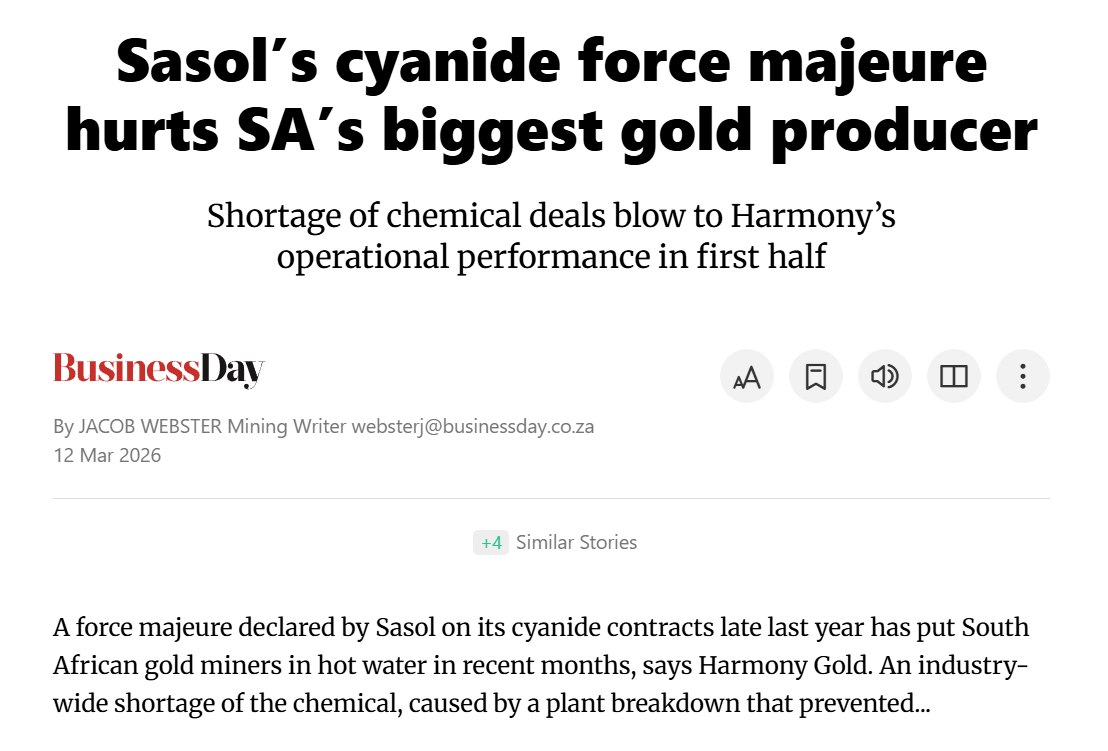
A disruption therefore doesn’t have to eliminate world cyanide production to become significant. Remove an important plant, interrupt like Sasols ammonia or caustic-soda supply, or constrain the specialised transport required to move cyanide safely, and mines can’t necessarily replace the missing tonnes simply by ordering from somebody else.
The dependency extends far beyond gold. A gold mine can possess millions of tonnes of ore, functioning excavators, electricity, mills and workers and still lose production because it can’t obtain a comparatively small flow of sodium cyanide.
A copper operation can have an enormous mineral resource but insufficient acid or solvent-extraction reagent to recover the copper economically. A lithium processor can have concentrate piled at its gate but lack a chemical required for conversion.
A rare-earth facility can possess concentrate containing valuable elements but be unable to separate them into useful products.
A battery recycler can have tonnes of spent batteries waiting to be processed while a shortage of acid or another reagent constrains its hydrometallurgical circuit.
The implication is easy to miss because we tend to think of natural-resource security in terms of possession of the resource itself. Countries count tonnes of lithium, copper, uranium, rare earths and gold in the ground and describe those deposits as strategic resources.
But a mineral deposit isn’t the same thing as a supply of metal. Between the rock and the finished material sits an enormous chemical-processing system.
The habits of a lifetime are going to die hard. Its going to take years for every sector, political, economic, financial, mining, manufacturing to fully internalise the world of the past where we could rely on supply chains.
Owning the ore doesn’t mean controlling the chemistry required to turn the ore into a commodity. Its a new world .
There’s an additional irony because the dependency runs in both directions. Metal processing itself can produce important chemicals. Copper smelters, for example, capture sulphur dioxide released from sulphide concentrates and convert it into sulphuric acid. That acid can then be used elsewhere for mineral leaching, fertiliser manufacture, chemical production and battery recycling.
Mining supplies raw materials to chemical plants; chemical plants provide reagents to mines and refineries; those mines provide the copper, nickel, lithium and other metals required to build chemical plants, electrical networks, vehicles and energy infrastructure. Both systems depend in turn on energy and transport.
The supply chain therefore isn’t really a chain. It’s a network of causal loops.
A failure that begins with centimetres of water beneath a Rhine barge can therefore propagate through a surprisingly long industrial system:
low Rhine water → restricted bulk transport → chemical feedstock shortages and reduced production → tighter supplies of acids, alkalis and specialist reagents → constrained mineral extraction, refining or recycling → tighter supplies of metals → pressure on industries that depend on those metals.
The effects needn’t occur everywhere, and Europe isn’t the world’s sole supplier of these chemicals. Alternative producers, inventories, rail, road and international trade provide important buffers. But redundancy isn’t unlimited, particularly for hazardous chemicals, qualified specialty reagents and products manufactured by relatively few suppliers.
The significance of the Rhine isn’t that closing it automatically stops the world’s mines. It’s that the river gives us a window into how interconnected modern industrial production has become.
A drought can begin as a transport problem on a European river, become a chemical-production problem inside an integrated industrial complex, and eventually emerge thousands of kilometres away as a shortage of something required to extract or refine a metal or produce fertiliser.
The mine may still have its ore. The refinery may still have its concentrate. The workers and machinery may all still be present. What the producer may no longer control is the chemical system that makes the resource usable.
The scarce resource, in other words, isn’t always the mineral beneath our feet. Sometimes it’s the chemistry that allows us to get it out.
Why trucks can’t become a river
When a river stops carrying freight, the obvious response is to move the freight onto land. This sounds much easier than it is.
A single large barge can replace scores of trucks. For some bulk cargoes, current industry estimates suggest replacing one barge can require as many as 150 trucks. Replacing thousands of barge movements would therefore require a massive simultaneous mobilisation of specialised trucks, certified chemical tankers, drivers, loading infrastructure, hazardous-material permits and expanded rail capacity. (Reuters)
A freight train can carry far more than a truck, but trains require locomotives, drivers, wagons, train paths, sidings and terminals. Chemical freight often requires specialised wagons. And displaced Rhine cargo doesn’t enter an empty railway. It enters a railway already carrying freight and passengers.
This is why the idea of modal substitution can become misleading. Road and rail are alternatives at the margin. They aren’t dormant duplicate Rhine rivers waiting to be switched on.
Another complication emerges now that we’ve followed the molecules downstream. The chemical producer and its customer often share the same alternative transport system. The emergency truck carrying chemical feedstock uses road capacity also needed by the converter, component manufacturer, automotive supplier, and factory assembling the finished product. The same is true of rail.
Moving Rhine freight onto land therefore doesn’t simply require spare transport capacity. It can force different layers of the same production system to compete for it.
This is the hidden consequence of geographic stacking. Chemical plants and the factories they supply clustered around shared infrastructure because that made the whole system efficient. During a disruption, they also become competitors for that infrastructure.
We’re already seeing versions of this. German states have relaxed some trucking restrictions to create more road capacity as Rhine shipping has deteriorated. That helps, but it doesn’t manufacture thousands of tanker trucks, trained drivers, specialised rail wagons or terminal slots overnight. (Reuters)
The company that solves part of its own logistics problem by buying scarce trucks or rail paths can therefore transfer some of the constraint to somebody else.
The bottleneck moves.
Water creates a second constraint
Chemical plants and power stations use enormous quantities of water for cooling and industrial processes. During extreme low-flow periods, the problem therefore becomes two-dimensional. A chemical complex can lose transport capacity at exactly the same time that it loses cooling flexibility.
This happened at Ludwigshafen in 2018. BASF reported that restricted raw-material supply and insufficient cooling-water availability contributed to production limitations. BASF’s subsequent reporting confirmed that low Rhine water was constraining both logistics and cooling. (BASF)
Heat makes this worse. Low flow means less water, while hot weather means warmer water. Warmer river water removes less heat from industrial processes, and environmental limits can restrict the temperature at which cooling water may be returned to the river.
So the same weather event can attack the factory from two directions at once: lower river flow reduces freight capacity while higher river temperature reduces cooling capacity.
Solving one problem doesn’t solve the other. A train can deliver naphtha. A train can’t deliver a functioning Rhine-sized heat sink.
This is why the current crisis shouldn’t be described simply as a logistics disruption. It’s potentially a multi-system industrial constraint.
Efficiency creates hidden concentration
The relentless drive to reduce costs encourages industries to cluster around shared infrastructure and integrated supply chains. This creates a paradox: the same economic efficiency that makes a system more productive can also concentrate its vulnerability.
Efficiency creates concentration, and concentration creates systemic importance.
The Rhine became indispensable partly because it was so useful. The Ludwigshafen Verbund became enormous partly because integration created extraordinary efficiencies. Karlsruhe’s refinery, Strasbourg’s port system, Chalampé’s chemical cluster, Basel’s logistics infrastructure and the great Lower Rhine chemical sites all grew inside a wider industrial geography that rewarded connectivity.
Geographic stacking is therefore not an accident. It’s the physical result of decades of rational economic decisions.
But once enough production becomes concentrated around the same infrastructure, that infrastructure stops being merely an efficiency advantage. It becomes a point of systemic dependence.
That isn’t an argument against integration. It’s simply a reminder that efficiency and resilience aren’t the same thing.
Force majeure as a diagnostic instrument
Monitoring industrial stress requires more than counting force majeure declarations. The useful information comes from mapping where those declarations occur across the chemical tree.
Base-network chemicals such as ethylene, propylene, chlorine, ammonia and butadiene carry enormous weight because they support large downstream branches. The seriousness of a disruption depends on how far upstream the chemical sits, how easily it can be physically substituted, how much inventory exists, how concentrated production is and whether alternative producing regions are suffering constraints at the same time.
The current Rhine event gives us an early example of what such a map would look like. Polyols at Dormagen, plasticisers and surfactants at BASF, butadiene at Wesseling, reported phthalic anhydride at Uerdingen and constraints at Marl aren’t economically identical. They sit at different levels of the chemical tree and feed different industries. (Reuters)
But once several branches begin failing together, the pattern itself becomes useful information.
Force majeure therefore becomes more than a legal event. It becomes a diagnostic instrument for the physical economy.
An effective early-warning system would map each declaration according to the chemical’s position in the production tree, its immediate substitutability, available inventories, geographical concentration and the condition of alternative suppliers elsewhere. Concurrent failures in Europe, Asia or the Middle East would then be overlaid rather than analysed separately.
That would tell us far more than simply counting how many companies have issued notices.
A multipolar world changes the mechanics of industrial failure
The migration from a largely unipolar trading system toward a more fragmented, multipolar one changes the mechanics of industrial failure.
During the decades of deep global integration, the chemical network operated as a relatively fluid international system. If a European cracker went offline, Asian or North American producers could sometimes increase utilisation or redirect exports. Molecules crossed oceans, trade barriers were generally lower, and emergency arbitrage provided a degree of shock absorption.
That system was never frictionless. Specifications, shipping distances, qualification requirements, contracts, tariffs and hazardous-goods rules always constrained substitution. But a more integrated world offered a larger pool of potential substitutes.
A more fragmented world reduces some of that flexibility.
Governments increasingly treat critical chemicals, energy systems, minerals and strategic materials as matters of national security. Tariffs, export controls, sanctions, security rules and strategic decoupling can turn a supplier that exists physically into a supplier that’s unavailable commercially or politically.
This changes the way a force majeure can cascade through the system. A naphtha shortage in Europe doesn’t disappear simply because Asian storage tanks are full. The material must be available for export, legally accessible, commercially viable, compatible with the customer’s process, and capable of reaching Europe before inventories run out.
Likewise, Asian capacity isn’t a useful substitute if Asia itself is still rebuilding inventories after a Middle Eastern feedstock shock.
Geopolitical fragmentation therefore doesn’t eliminate cross-border substitution, but it can shrink the pool of substitutes that actually matter. Industrial stress testing needs to account for this by overlaying political boundaries onto the physical chemical network.
A molecule doesn’t care where the border is. The supply chain does.
The ghost of 2018
The 2018 Rhine crisis proved that partial navigation constraints could cause substantial industrial losses. BASF suffered severe production limitations and an earnings impact of roughly €250 million when Ludwigshafen lost reliable access to river-borne raw materials. (BASF)
Chemical companies subsequently adapted. BASF and other operators invested in low-draft vessels, expanded alternative transport arrangements and increased physical storage buffers. BASF’s own logistics material describes how the company expanded rail capacity and introduced vessels designed to operate at lower water levels following the 2018 experience. (BASF)
Those measures matter, but each operates within a physical limit.
A low-draft vessel still requires water beneath it. A truck fleet carries only a fraction of a river’s bulk capacity. A railway requires wagons, locomotives, train paths and terminals. Expanded storage tanks buy time, but they don’t create new feedstock.
Industrial adaptation therefore shifts the threshold at which failure begins. It doesn’t remove the threshold.
The 2026 event is testing where that new structural breaking point now sits.
What makes this event particularly interesting is that we can already see several stages of the cascade at once. Logistics disruption is established. Individual production constraints are established. Multiple force majeure declarations across connected chemical branches are established. A major upstream butadiene unit has been affected. Road and rail substitution are under pressure. The Upper Rhine risks losing continuous access to the North Sea freight system at Kaub. (Reuters)
What we haven’t yet seen is widespread failure across the major base-network chemicals or large downstream shutdowns across automotive, construction, mining, fertiliser or other manufacturing sectors because of these shortages.
This isn’t an argument that the entire industrial system is about to collapse. It’s an argument that the early stages of a physical cascade are now visible, and that our usual way of thinking about supply chains tends to underestimate how those cascades can travel.
We see companies, contracts and markets because those are the things we can price. Underneath them sit rivers, ports, pipelines, railways, trucks, crackers, chemical plants, storage tanks, mines, refineries, converters, component suppliers, cooling systems and power networks.
A company can have five suppliers and one physical supply chain. A country can have a mineral deposit and still lack the chemistry required to turn it into metal. A refinery can have crude oil and still struggle to move its finished product.
A chemical plant can have its feedstock and still lose cooling water.
A factory worth billions of dollars can still stop because a tiny material worth almost nothing is missing.
Modern industry has become extraordinarily efficient at hiding these dependencies during normal times.
The Rhine is making them visible again.
These great analytical pieces you are writing are a welcome smack in the face to the Orwellian dissemination of infantile fairy stories in the mainstream media and beyond featuring individual actors set up as heroes and villains and apparently, like Uber mensch, they shape our world. This is infantile theatre.
Here in your work is the complex reality in which we live and that most people are not encouraged to think about. Thanks for you work.
Great analysis - thank you for sharing it.