The Amputation Algorithm
How the Fed’s Models Are Financing Western Defeat

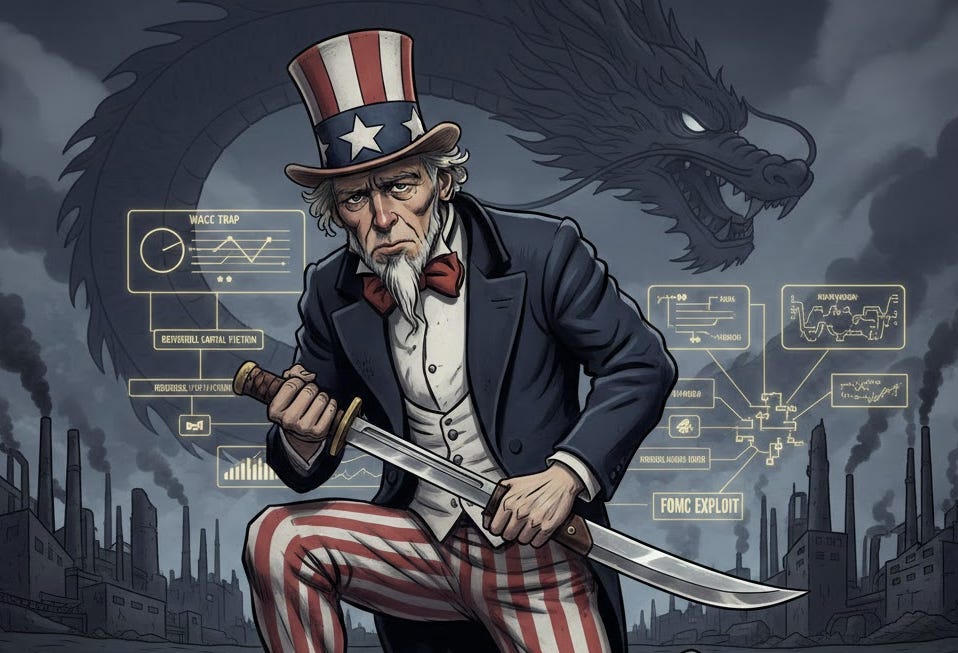
A central bank governs through measures, it watches prices, wages, rents, and the flow of credit. It sets a policy rate, conducts balance sheet operations, and relies on models that translate a complex economy into a tractable system.
That system has boundaries; it privileges what can be priced daily, cleared nightly, and revised quarterly. It handles consumption inflation and financial plumbing with care, treating capital as a stock that adjusts smoothly. It assumes that when conditions improve, activity returns; that's where the framework's calculus fails.
Heavy industry is outside the model, a huge blind spot. A smelter and a deep mine are the elephants on the couch beside us; they don't behave like a portfolio. They cross thresholds. The closure decision looks reversible in the calculus, but it collapses under reality. In the plant, once the threshold is crossed, the “option” to restart becomes a reconstruction project with a new cost base, a dispersed workforce, and degraded equipment. We know this because when we scrutinise them individually, they never ever behave as the Fed models suggest.
Economic models treat capital as an accounting object, disconnected from the material system that determines whether it still exists.
It's basically a monetary design built for a service economy, applied to an era in which sovereignty/rivalry rides on minerals, power, and midstream chemistry.
In the Miran interview, inflation is treated as an index built from methodological choices, lags, and imperfect proxies. He stresses that measured shelter inflation can lag the rental market by years and that components of core inflation can reflect accounting treatment rather than an underlying “price” in any ordinary sense.
A central bank that targets a constructed index must choose what the index stands for. In practice, CPI and PCE stand for household purchasing power within a consumption basket. They don't account for the cost of rebuilding productive capacity, the cost of restarting a frozen smelter potline, the lead time for mining fleets, the wage premium required to reassemble a crew, or the months lost to permitting and procurement.
The result is that when consumer inflation rises, the Fed tightens. Tightening transmits fastest into capital-intensive balance sheets: floating-rate debt, refinancing risk, hurdle rates, and equity dilution. In a service firm, that often means slower growth and layoffs. In a smelter or mid-cap mine, it can mean closure.
Central bank language treats monetary policy as a dial. Raise rates, demand cools. Lower rates, demand recovers. Lags operate. Forecasts update. The economy converges toward a path.
That picture fits sectors where capacity can be mothballed without ruin and restarted without reconstruction. I have tried my best to think of these sectors in the industrial sector, but none come to mind.
In the interview, Miran leans into the familiar triad: inflation, the output gap, and the neutral rate. He argues that technology shocks can be deflationary through cheaper production and higher supply, while the neutral rate can shift with population growth and national savings. He seems to have missed that he is using a stateless framework in an era of significant rivalry, which offers a rival an exploit dashboard.
Monetary policy thinks in quarters and a two-year horizon. Mining and smelting operate on five- to fifteen-year cycles. A Western project can face a three-year build, a two-year ramp, and a decade of payback. When the policy rate rises, the WACC and the hurdle rate rise as well. A project that looked viable at one discount rate fails at another.
The failure is a real shutdown: contractors released, orders cancelled, crews scattered, equipment sold, sites placed into care and maintenance, and then written off. In the age of accelerated aging demographics, skills retire.
In a rivalry economy, that is a strategic event. It changes who can supply, who can refine, and who can scale. In an age of unrestricted warefare our generals are fighting the old war, one where the action hero saves the day, whereas in this age, we are at war through the systems lens, state capitalism leveraging the exploits it can find in stateless capitlism
Miran spends time on the boundary between ample and scarce reserves and on how regulation shapes that boundary. This is the Fed’s natural habitat: reserves, repo rates, collateral, the mechanics of Treasury issuance and reserve drainsfed
Yet the kind of scarcity that is existential to state survival is different. It is not a reserve threshold. It is the availability of long-duration, low-cost capital that can survive commodity cycles and construction overruns. That's the Chinese monetary hypersonic missile, FOMC exploits that the Fed PHDs doggedly refuse to acknowledge
It is the willingness to fund a ramp-up phase where mistakes are common and early quarters disappoint. It is the capacity to carry assets through downturns without forcing liquidation.
A balance-sheet regime can be “ample” in reserves and still starve industry. The monetary system can be liquid while the industrial system dies.
Frame this concept in your lens because it is essential and somewhat inevitable that this lens be adopted broadly. It's better if we adopt this lens asap. It draws a line between financial liquidity and industrial liquidity. The Fed manages the former. China’s model is built to command both.
Alexander would have seen the cavalry turning his flank; Napoleon would have felt the encirclement. We are watching the monetary maneuver in real time and thinking it's weather.
A market system prices risk in terms of volatility and uncertainty. It demands high returns to compensate. A state system prices risk as strategic exposure and treats supply security as the return. That is a really simple concept.
When a Chinese policy bank funds a miner or a smelter on long maturities at low rates, it compresses the cost of capital and stretches the horizon. That single move changes what survives downturns, what gets built in troughs, and what gets acquired when Western firms fail.
The West reads stress as a signal to retrench. China reads distress as a signal to accumulate.
Think of it through this lens: an accounting regime rather than a time regime. One side discounts the future hard. The other side treats the future as the object. Chess grandmasters understand this hat put that hat on.
Some assets restart like a switch; others, like an industrial rebuild. Onshoring is an example of this type of lag.
A smelter’s potline is not a warehouse. A mine’s underground workings are not an office lease. The models we are using are too coarse to capture this reality. If closure triggers thermal failure, corrosion, equipment cannibalisation, loss of licenses, or loss of workforce, then “shut” becomes a different state of matter than “idle.”
If the policy framework treats shutdowns as temporary slack, it will lead to tightening decisions that look prudent in the model but destructive in the plant. This eventually leads to vassalage.
The math assumes continuity; the world contains thresholds. In a system governed by thresholds, policy must treat closure as capital destruction rather than a pause.
No debate. A Western central bank cannot become a Chinese policy bank without changing its mandate.
Yet rivalry forces an existential question: what must be priced explicitly because markets will not? Why can't "markets " price it? Because the rival is exploiting the pricing signal implicitly and explicitly.
A material lens would add three variables to the Western policy conversation:
Capacity survival as an input to stability, alongside inflation and financial conditions.
Irreversibility risk is a distinct class of risk, separate from volatility.
Duration matching between the time scales of strategic industries and finance.
This does not require romantic language about industry. It requires admitting that certain closures behave like amputations, and that the economy does not regrow limbs on the timetable of a policy cycle.
A consumption-index central bank, operating with reversible-capital models, will keep tightening into conditions that permanently erode industrial capacity, and rivals with state-anchored capital will buy the wreckage. Read that twice.
It also shows the boundary of that mind: policy still speaks the language of aggregates that smooth away phase changes. Miran’s interview shows a Fed mind attentive to measurement issues, lags, and the mechanics of reserves.
That is the point of friction between financial capitalism and material survival. At the moment, the Fed is unknowingly selecting for sovereign defeat.
And remember this lens for my coming essay on India, where we look at the impacts of a consumption-based monetary framework on an emerging economy
“The monetary system can be liquid while the industrial system dies.” Outstanding piece. I hope someone in HM Treasury reads it before. It’s too late.
Whose ox will be gored, whose reputation will be ruined? Reinvention is difficult.
Boomers do not have the foresight required by the future. Confirmation bias is the easily transferred plague.
Let us hope that our rivals are wise enough to prolong the interdependency that exists. Less Rambo, more Survivor awareness.