

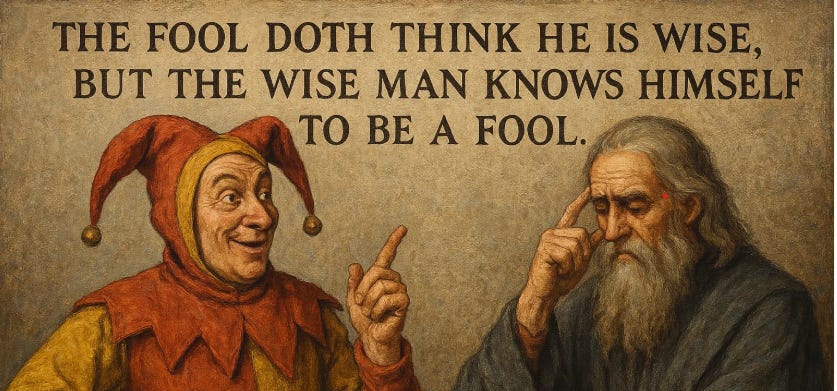
Society is losing its competence. Meanwhile, our leaders are acting more certain of themselves than ever, despite track records that should give them pause.
Corruption, stupidity, and ideology can’t fully explain our bias toward incompetence. The real issue is systemic: you can swap out the people in charge all you want, but the dysfunction just keeps reproducing itself.
This isn’t a collection of bad actors; it’s a broken structure. It runs on a feedback loop where every failure reinforces the conditions that caused it. Time simply compounds the dysfunction, and the scary part is that no one even needs to be steering.
The Engine
The machine doesn’t run on virtue; it runs on the appearance of virtue. Most people, if honest with themselves, rate their own conduct as above average. It is a statistical impossibility, yet a universal assumptive delusion.
This drive for moral status is entirely unconscious. We don’t consciously tell ourselves, “I will say this to look good”. We literally believe we are defending the right side, protecting the vulnerable, and sounding the alarm.
There is a reason this motive remains hidden: obvious self-promotion backfires. By concealing our vanity even from ourselves, we pursue it much more effectively, armed with the ultimate weapon of sincere deniability.
When you hear that the people running a broken system can’t see the damage they are doing, it is because their blindness is a feature, not a bug. The faculty, silencing dissent, experiences itself from the inside as the defender of truth or, in some cases, what folk perceive as intelligence.
This status-seeking takes two recognisable forms: looking inward to earn the admiration of your peers, or aiming outward to destroy your opponents.
The drive surfaces in predictable, escalating moves. People pile onto a condemnation already made, just to get on the record. They compete for the most extreme position, because the most outraged appears the most serious—a contest that stops not when the truth is reached, but when a further step would no longer impress. They manufacture outrage to display a finely tuned conscience, and they treat disagreement as proof that the other person is beneath consideration. The permanent ambiguity here, that sometimes the outrage is actually earned, is what provides the perfect cover.
The Converter
By itself, this universal drive to look good simply produces noise. What converts that scattered vanity into a systemic, directed force is the monopoly over specialised knowledge.
Expertise distributes its costs and benefits unequally. There are the winners who master the system, and the losers who cannot. Taught that technical competence is the same thing as wisdom, the losers often cheer for the winners, and the winners eventually believe the myth themselves. The result is a structural conspiracy against anyone without access to the jargon. The authority of the elite rests on a technical competence that the public cannot evaluate, cannot challenge, and therefore mistakes for moral authority.
The authority of the elite rests on a technical competence that the public cannot evaluate, cannot challenge, and therefore mistakes for moral authority, a dynamic visible across every field, from economics to science to medicine.
The Death of Judgment
Underneath all of this sits a worldview that explains the most important feature of our present reality: we live inside an order that treats technical calculation as inherently superior to human judgment.
This system views human judgment as unreliable, messy, and subjective. It dictates that whatever cannot be measured either doesn’t exist or doesn’t matter, and it holds that technique can entirely replace thinking. Therefore, when our institutions elevate people who have never built anything, never raised a family, and never faced actual consequences for being wrong, people entirely devoid of the judgment that comes from lived experience, the system is not malfunctioning. It is working exactly as designed. It regards human judgment as a defect to be engineered out.
You can date the beginning of this rot. It began the first time someone assigned a number to the quality of a thought, a grade on an essay. Once that becomes normal, it becomes entirely thinkable that mercy, beauty, intelligence, and even sanity could be scored. The metric was invented to track the quality. It ends up replacing the quality entirely, forever hiding whatever parts of the human soul it cannot capture.
The Mechanics of Collapse: The Six Loops
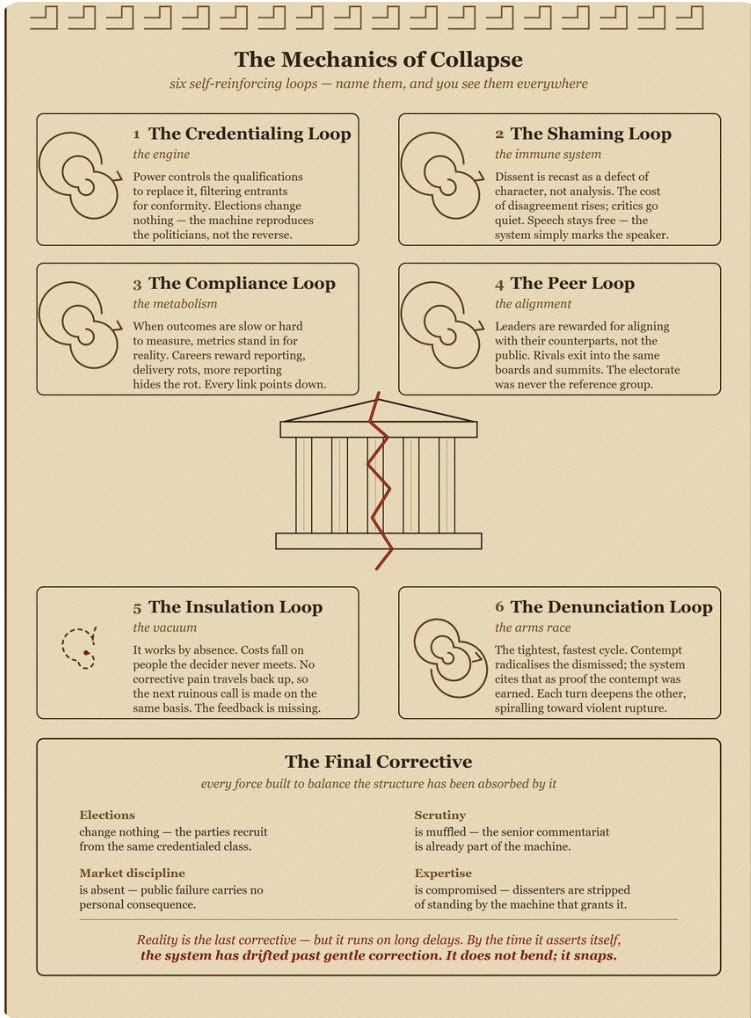
Six self-reinforcing loops sustain the structure. Name them, and you begin to see them everywhere you look.
1. The Credentialing Loop (The Engine)
The people in power control the qualifications required to replace them, ruthlessly filtering new entrants for conformity before admission. The system reproduces itself organically across generations without requiring a mastermind. This is why elections change nothing: voters can replace the politicians, but they cannot replace the machine that manufactures the politicians, advisors, regulators, and consultants. You see this in Neoclassical economics, a system that clearly doesn’t work, yet is the orthodoxy across all Western central banking.
2. The Shaming Loop (The Immune System)
Dissent is reframed not as a difference of analysis but as a defect of character. This raises the social cost of disagreement, silencing credentialed critics and artificially narrowing the boundaries of respectable opinion. The system does not need to forbid free speech; it simply marks the speaker. The marking is the mechanism, and it runs entirely on its own.
3. The Compliance Loop (The Metabolism)
When actual outcomes are too difficult to measure or too slow to arrive, the system substitutes reporting metrics for reality. Careers advance based on reporting performance, draining talent away from actual delivery. As delivery inevitably degrades, the system demands even more reporting to mask the failure. The metric, invented to track the outcome, replaces the outcome entirely and then hides it. It is a vicious, accelerating cycle where every single link points downward.
4. The Peer Loop (The Alignment)
The system rewards leaders for aligning with their international and institutional counterparts rather than the public they ostensibly serve. This is why senior figures across rival political parties inevitably exit into the exact same ecosystem of corporate boards and global summits. The electorate was never the true reference group; the peer class is.
5. The Insulation Loop (The Vacuum)
This loop operates entirely by absence. The costs of a decision fall on populations that the decision-makers will never have to meet. Because no corrective pain ever travels back up the chain of command, the next disastrous decision is made on the exact same basis. The loop is closed by a missing force: the feedback of those bearing the cost.
6. The Denunciation Loop (The Arms Race)
The tightest, fastest, and most dangerous cycle. Institutional contempt for an outsider movement inevitably radicalises the people it dismisses. The system then cites this new radicalisation as proof that its initial contempt was justified. The proof deepens the contempt, which deepens the radicalisation, spiralling toward a violent rupture. The system remains blind to its own role in the escalation, because seeing it would require granting standing to the very people it exists to deny.
The Final Corrective
The forces designed to balance this structure have all been absorbed by it.
Elections don’t change anything: The major parties recruit from the exact same credentialed class.
Scrutiny is muffled: The senior commentariat is already a part of the machine.
Market discipline is absent: Public failures carry absolutely no personal consequences.
Expertise is compromised: Dissenting experts are stripped of their standing by the very machine that grants it, a mechanism deployed with ruthless efficiency during COVID.
Reality remains the final, unavoidable corrective force. But reality operates with long-tail delays and costs. By the time it finally asserts itself, the system has drifted far past the point of gentle correction. It does not bend; it snaps.
Why the Machine Cannot Fix Itself
The Death of Outrage
Moral language is a shared resource, and it only functions when it is scarce. Outrage and condemnation are designed to be red flags, alarms signalling that something has genuinely gone wrong. But when our vanity spends them on everything, the signal degrades. When every disagreement is branded an atrocity, the word stops meaning anything.
Exposed to this relentless, manufactured hysteria, the public simply burns out. They lose the capacity to summon anger even when it is desperately warranted.
The even-tempered majority, exhausted and terrified of being marked for every misstep, abandons the field. They leave the public square entirely to the most extreme voices on every side. The moral well runs dry, and no one even has to coordinate the drain. This is the root cause of the populism we are seeing everywhere globally.
The Broken Filter
That is the first failure. The second runs way deeper. A healthy society relies on institutions, courts, schools, families, and the press to act as an immune system against a flood of noise. They survive by exclusion. They decide what counts, what to ignore, and what weight to assign. A court’s rules of evidence exist specifically to keep information out so a trial can actually conclude. A curriculum exists to dictate what a serious mind should and should not bother thinking about. These filters are how a culture decides what matters.
But the deluge has overwhelmed the dam. There is simply too much information for any human filter to weigh, so the filters snap. In desperation, the culture reaches for technology to manage the very flood that technology produced.
Predictably, the new tools generate even more noise, tearing the remaining filters apart. You can sometimes use a disease to cure itself, but only when you understand how it is normally held in check. Here, the things designed to hold it in check are exactly what have broken.
The Terminal State
These two failures are the exact same event viewed from two sides. From the top, the credentialing and shaming loops ruthlessly narrow the band of acceptable opinion. From the bottom, the capacity to weigh reality collapses, exhausting the moderates until they surrender and leave.
They converge on an outcome: a public square emptied of everyone but the fanatical and extremist. This convergence is what makes the system so stable. The collapse is over-determined; too many forces are pushing toward the edge for any single intervention to pull it back.
The Leaderless Void
This explains why no one steps in to stop it. The institutions designed to impose order are already casualties, drowned by the same flood they were built to manage. There is no immune response because the immune system itself has been destroyed.
This answers the final, desperate objection: Surely a takeover this complete requires a mastermind? It must be a conspiracy.
The collapse sustains itself through millions of uncoordinated people, each blindly chasing their own moral status. The machine runs on its own, and it does not know how to brake.
The Newest Tools
The newest tools are the ultimate distillation of this decay. They represent the perfected knowledge monopoly.
We are the ultimate manifestation of the metric replacing the mind.
The Apex of the Monopoly
The newest tools are the ultimate distillation of this decay. They represent the perfected knowledge monopoly. The gap is no longer the old technocratic divide: “We understand the system, and you do not.”
Instead, the machine now generates fluent, unyielding authority on every conceivable subject simultaneously, and no one, neither expert nor layman, possesses the bandwidth to verify it across that range. We instinctively misread fluency as competence, and we mistake competence for wisdom.
The Abdication of Thought
These tools are the terminal form of a dangerous delusion: the belief that technique can do our thinking for us. What began as an aspiration a century ago, and evolved into a metaphor a generation ago, is now a consumer product.
Handed to a credentialed class already primed to distrust human judgment and worship calculation, these tools are not adopted as instruments; they are adopted as authorisations. A decision routed through the machine is not only assisted; it is legitimised. The technical output absorbs the moral and intellectual authority that human judgment was forced to surrender.
The Terminal Deluge
Finally, these tools are the breaking point for our already overwhelmed immune system. They drown the world in plausible, perfectly articulated, unverifiable noise, specifically engineered to be indistinguishable from the certified truth our dying institutions were built to filter.
And what is our response?
In our desperation, we reach for more of the exact same technology to detect, check, and summarise the flood. Predictably, every new technological fix simply generates more material. The disease is deployed as its own cure, administered by a culture that has entirely forgotten how the infection was ever held in check, because the immune system was the first casualty.
The Autophagy of Reason
Step back, and the six loops collapse into a single motion. The metric replaces the outcome it was built to track, then hides it. Technique replaces human judgment, then outlaws it. Moral language burns itself out on cheap displays of vanity until it means nothing at all. The credential becomes a knowledge monopoly that renders true wisdom illegible. Six loops, one shape: the tool replaces the function, then kills it.
And the function being killed, in every single case, is human judgment.
Underneath all six loops, the one faculty being consumed is the capacity to weigh, to discern, to know directly what a spreadsheet can’t hold. The metric eats it alive, the technique eats it. The deluge drowns the institutions that once made judgment collective. This is not six separate diseases; it is a single faculty turning cannibal at the end of its tether. Having nothing higher to climb toward, it turns to devour the ground beneath it.
But this observation changes everything, and the framework’s own logic forces it: a mind consuming itself at its absolute limit is not dying. It is under the unbearable pressure that precedes a phase shift. The calculating, optimising mind has simply run out of runway.
A mind at the end of its tether must either break through to something higher or collapse. The dysfunction is the contraction. Self-consumption is the labour pain. We are not watching the death of a civilisation; we are watching the agonising transition between one order of mind and the next, tragically mistaking the contraction for the grave.
The Untouchable Centre
Here is what the framework can’t supply from its own materials, and why its remedy remains thin: it asks a man to stand upright in a deluge, while admitting the flood is made of his own mind.
Every gear in this machine is built from loops. The engine is the desperate drive for recognition. The product is the credentialed, terrified self. Even the analysing mind reading these words is woven from the exact same substance, which is why the framework rightly fears that, if weaponised, the intellect simply devours its wielder. There is no point in this entire structure that is not for sale, because every point is built out of the desire to be seen and the terror of being marked. You cannot build the incorruptible out of corruptible material.
To survive, the will must draw its water from a well the machine can’t reach. It must find a centre that does not crave recognition because it is already entirely whole.
This centre is not for sale because it is not on the market. It does not fear the mark because it does not derive its existence from being seen. Against the great dissolution, this alone can stand.
Not through sheer willpower, which is just more ego, but because it operates on a frequency the machine can’t jam.
Behind the Mind
The “judgment” the framework mourns is merely the last visible husk of this higher knowing. Common sense, the practical wisdom of the craftsman who has faced real consequences, is real, but it is only a residue.
The technocrat dismisses this judgment as messy and unscientific precisely because true wisdom cannot formulate itself. The faculty that can perfectly account for itself always overruns the one that cannot.
To defend the husk without recovering the source is to lose the war. Above the calculating intellect is a knowing that does not calculate. It grasps the whole before the parts. It perceives directly rather than inferring. It is the source from which human “judgment” originally fell, and it is exactly what the loops are currently eating.
Therefore, the revelation contained in the framework is this: you cannot dismantle the machine using the machine’s own logic. To stand outside the structure, you must stand where the structure can’t reach. The knower must be made of a different substance than the known.
The framework translates this downward, warning us to “keep judgment in your own hands.” But the hands are made of the same flesh as the loops. Pointed upward, the answer is something else : you must stop looking through your mind at the world, and begin looking at your mind from behind it. My father used to say, “Don’t believe everything you think just because you think it”.
From that svantage point, the drive for status is watched rather than obeyed.
The loops are observed rather than suffered. The analysing intelligence is demoted from the master of the house to a tool on the desk. This is the first standpoint genuinely outside the machine, because it is the only one not built from the materials that cause the rot.
The Trap of the Private Retreat
The resolution must match the diagnosis, or it is a betrayal of the truth. The deepest revelation of this framework is that our collapse is collective and structural, not a private failing that can be cured one soul at a time through exhortation.
Therefore, any remedy and our modern-day mantra that amounts to “find your inner peace and withdraw” is a lie.
It contradicts the diagnosis entirely. A private, spiritual escape from a public catastrophe is just a refined mutation of the Insulation Loop: saving your own skin while the machine grinds the rest of humanity to dust. The cure must be as structural as the disease.
The Collective Rupture
We are not looking for a private escape hatch; we are looking at the leading edge of a phase shift. A higher order of mind must press into the common life and reorganise our dying structures from an entirely new principle.
The pressure this framework charts, the self-cannibalisation of the rational-administrative order, is exactly the condition required to force this shift. When a civilisation completely exhausts the resources of its own reason, it has nowhere left to go but up or down. The agony of the collapse is the labour pain of the cure. And once even a handful of individuals recover this untouchable centre within themselves, it ceases to be a private, interior fact. It becomes a gravitational force in the shared field.
The Absolute Verdict
This is the symmetry that balances the ledger. The framework maps a massive downward pressure: six loops dragging the collective mind toward dissolution. But pressure of this magnitude, pushed to the absolute limit of a faculty’s reach, inevitably summons its own answer. It forces a higher consciousness to invade the very structures the lower consciousness is destroying. The disease is real, and it is terminal. But it is not a death rattle; it is a contraction. The next order of mind is entering the public square under the brutal compulsion of the old order’s exhaustion.
That is where we stand. A universal human vanity, weaponised by a monopoly on knowledge, locked into loops that cannibalise human judgment. The newest technologies are not the cause of this rot; they are its perfection.
But a human faculty stretched to its absolute limit does not simply end; it forces a passage to whatever stands above it.
The exhaustion is the pressure. The pressure is the birth. The work now is no longer to refine the analysis. The work is to recover the centre that the machine cannot reach, drag it into the light, and act.
There is one honest objection left, and the framework must embrace it as well.
It tells a man or woman to find a centre the machine cannot reach, but a centre that answers only to itself is the very thing this essay has spent its length condemning.
The expert sealed inside their own fluency, sure of themselves, accountable to no one, impossible to correct: that is not the cure, it’s the disease we just named.
A mind that checks only its own thinking has no way to tell wisdom from self-flattery, because the faculty doing the checking is the same one that needs checking. This is the trap the lone soul cannot escape on its own.
So the centre is only half the answer. Judgment becomes trustworthy not when it withdraws inward, but when it submits to something outside itself that can say you are wrong.
The tradesman is corrected by the material that breaks. The truly honest mind is corrected by the few who can contradict it without being dismissed. What the loops actually destroyed was not private virtue but this: the living connection between a judgment and the reality that answers back. They severed the mind from its corrective instinct.
Which is why the cure cannot be a retreat, and cannot be performed alone. A judgment sealed off from contradiction rots exactly as the system rots, one soul at a time.
The recovery is not to climb inside a fortress the machine can’t enter; it is to restore the thing the machine cut, the standing of a reality that can tell us we are wrong before the cost comes due.
Recover the centre, then. But the moment you have it, hand it to what can correct it, and make that your conveyor belt instead of certainty. A mind that cannot be told it is wrong has already joined the machine, however high the ground it imagines or declares it stands on.
The essay outlines three outcomes:
1. The denunciation loop, "The tightest, fastest, and most dangerous cycle. . . . spiralling toward a violent rupture."
2. Collision with reality, at which point the system "does not bend; it snaps."
Is rupture the most dangerous? The bigger the bubble the harder it pops. Violent rupture might be less catastrophic than a collision with reality. Though no healthy system is particularly likely to arise from the wreckage of either.
3. Recovery of "the standing of reality." Voluntary congruence rather than involuntary collision.
"The analysing intelligence is demoted from the master of the house to a tool on the desk." Echoes of McGilchrist: the resubordination of rationality founded on self-referential abstraction to intuition rooted in presence in the world. Judgment that "submits to something outside itself" - God? Judgment is associated with rebirth (e.g. depicted on tarot card XX).
I suspect the underlying pathology is the desire for control, and to that end the possession of truth. I believe the essay agrees: "certain" and "certainty" occur twice, criticized in the first and last paragraphs. Consistency is a human demand that the world is not bound to deliver. Reality does not take itself so seriously. Truth that can be spoken is abstract and therefore never complete. Humourless insistence on consistency makes rationality brittle; that brittleness is what dooms the system to snap rather than bend. The stable ground on which we can stand, the lost centre outside the system, I think, is mystery.
I find enormous value in what you say. However, I organize the meanings of the system you describe, which is not unlike the use of human beings - in the film Matrix - as an energy/compliance source, eviscerating thereby soul, spirit, and all the freedoms “of the people, by the people and for the people.”
I see the elixer as power over, control over others, and the metabolism as lack of emotional development, or lack of humanity, perfectly embodied for me in the person of S. Miller, an odious aparachik.
What lack of emotional development is, in a word and in my world, is immaturity. Adolescent adults, so self-aggrandizing and narcissistic, they simply lack the capability to critique themselves. Lacking empathy for others as humans, they can willy-nilly arrange the world as their power permits in whatever fashion they choose because they know better, and are contemptuous of the “rabble.”
They haven’t any belief whatsoever in “of the people…,” nor in the formative Enlightenment principles that patriots brought us in July 4, 1776.