You Cannot Unsee the Loops.
The Self-Reinforcing Derangement of Australia’s New Ruling Estate

We seem to be watching a collapse of competence across every level of government and society. The diagnosis people reach for is usually corruption, or stupidity, or ideology.
None of these quite fit because none explains why the dysfunction is self-sustaining. What we are watching is not a failure but a feedback system, a structure of mutually reinforcing loops that produces the same outcomes regardless of who occupies its positions. Once you can see the loops, you can see the pattern. Once you can see the pattern, you cannot unsee it. This essay in attempt to explain the mechanics of what is happening.
I had this conversation with one of my tradies who lives in NW Sydney. He runs an air conditioning business that he built over thirty years, employs 4-5 people, and watched his quarterly power bill rise from around $4,000 in 2019 to over $11,000 by last year. He hasn’t had a pay rise in that time. Two of his apprentices have left the trade. He voted Labor most of his life, voted Liberal once for Howard, and last election voted One Nation for the first time.
When his daughter, who works in HR in the city, came home for Christmas and called him a racist over dinner, he stopped speaking to her for four months. He told me he couldn’t work out which part hurt more, being called a racist, or watching his own child use it as a weapon she had clearly been taught to use.
Notice the loop already forming around him. His vote registers a concern. The concern is reframed as a moral deficiency. The reframing is delivered by his own daughter, who learned it in an institution that selected her for cultural conformity before training her in the vocabulary she used to wound him.
His silence in response raises the cost of further dissent, for both him and everyone watching the exchange. The loop closes. His concern has been processed without ever being heard, and the system that processed it has been strengthened by the processing. There are millions of these people, Menzies would have referred to them as the “forgotten people”, and the same loop is closing around each of them every day, in a thousand small encounters that people deliver as moral hygiene.
It happened to me the other day. I was trying to explain, patiently, to one of my seven children why net zero does not actually achieve what its proponents claim.
The reply came back not as a counterargument but as an attempt to morally frame me. Which made me chuckle.
The debate moved very quickly. Do you believe climate change is real? I said I did. Then net zero must be good. The examination of the policy was not permitted. The retort to my constructive criticism was, “Well, we have to do something,” to which I replied, “That sometimes it’s better to do nothing than do something stupid”.
The question of whether the policy actually reduced carbon, whether the accounting framework was honest, whether the costs were proportionate to the benefits, and whether the execution was competent, none of these could be raised, because they had been collapsed into the prior question of whether I accepted the moral frame.
Once I had accepted that climate change was real, dissent on the policy became evidence of bad character. The policy was no longer a policy. It was a sacrament. To question its operation was to question the faith.
This is what a loop is. A self-sustaining structure or cultural framework in which the output of a system becomes the input that produces more of the same output.
A thermostat is a loop, but a corrective one; heat rises, the system cools, and balance is restored. The loops that interest us here are the other kind. Reinforcing loops, in which the output strengthens the conditions that produced it, and the next iteration runs harder.
Around the dinner table, the loop ran like this: my dissent triggered moral marking, the marking raised the cost of further dissent, my silence or retreat would confirm the marking was warranted, and the vocabulary that delivered the marking, learned at school, reinforced at work, ratified by every respectable institution my child has ever encountered, would emerge from the exchange stronger than it entered. No one had to plan any of this. The loop ran on its own, through my own child, who experienced herself as defending what is decent.
It is happening to all of us, every day, in a thousand small encounters. The subject can be climate change, immigration, gender, housing, vaccination, foreign policy, or the management of a public scheme.
The mechanism doesn’t vary. Express a view outside the orthodoxy and the response is not engagement but reframing, of you, your character, your fitness for decent company. The covenant is not about the policy. The covenant is about who is permitted to question the policy and on what terms; the terms are designed so that no question can be asked without the asker being marked.
This is a loop. It is the central loop of contemporary public life, and it runs in every household, every workplace, every common room, every comment thread, every Christmas dinner where a parent tries to say something true and watches their child instinctively reach for the vocabulary of denunciation.
The essay that follows is about that loop, the other loops that hold it in place, and the class of people who operate them without seeing what they are doing.
The pattern
The French Ancien Régime divided society into three orders: clergy, nobility, and everyone else, the last comprising roughly 98 per cent of the population. The first two estates were legally separated from the third, lived by different rules, paid different taxes, and shared a moral vocabulary that treated the commoner as a lesser form of person.
The arrangement collapsed because the loops that sustained it eventually consumed more of the nation than the nation could produce. The pattern is documented, repeated, and not unique to France.
The late Western Roman administration shows the same signature. The palace economies of the Late Bronze Age show it too. Stratified, ritualised societies can persist for a long time on the appearance of competence; the reporting layer holds, and then, when the underlying reality finally exerts itself, they undergo a phase change with little warning into something else.
That’s the essence of what disturbs many: they can see and feel the system’s exertion within the world they live in, but that alarm is transformed into moral judgments designed to silence.
The loops that maintain that separation are grinding everyone into an image of what we should think. There is a new First Estate, credentialed, administrative, transnational, that lives in different suburbs, sends its children to different schools, reads different media, holidays in different places, and increasingly regards the rest of the country as a problem to be managed rather than a people to be served. They do it unconsciously because their moral self-image demands of them, that they prevail over all others
Like the old clergy, it claims moral authority. Like the old clergy, it grows visibly less competent the more authority it claims. Like the old clergy, it consumes a steadily larger share of the nation’s resources while delivering steadily less. These are not unconnected observations. They are the visible outputs of a single self-reinforcing system.
This suggests that the old clergy are an archetype that can emerge from the secular as much as the religious
Where it came from
The estate’s history shows that the structure isn’t a permanent feature of modernity but a contingent, sequential formation. It assembled itself, loop by loop, over roughly fifty years.
The postwar expansion of higher education between 1960 and 1990 created, for the first time in history, a credentialed professional class large enough to staff entire countries. That class needed positions to occupy, and the growth of the regulatory state through the 1970s and 1980s supplied them. The credentialing institutions and the institutional positions began reinforcing each other almost immediately: universities trained the people who would occupy regulatory roles, and those roles created demand for more university-trained people. The first causal loop had formed.
The financialisation of senior public administration from the late 1980s onward, often through the mechanism of the consulting firm, fused the bureaucratic apex to the corporate apex, adding a second loop in which estate members rotated between government, consultancy, and corporate boards, each tour building the credentials required for the next.
The collapse of the Soviet Union in 1991 removed the external check that had disciplined Western elites for forty years, and a triumphalist ideology filled the space: the end of history, liberal democratic convergence, the inevitability of supranational governance, and that ideology supplied the moral vocabulary the estate would use to justify its own expansion.
The 1990s rise of the NGO archipelago and the great international institutions added the transnational layer. The 2000s rise of the global digital platforms added the cultural-reach layer. The post-2008 expansion of central bank power into territory previously reserved for elected governments removed a major balancing loop, democratic control over macroeconomic decisions, and left the estate freer still. In this case, it has its own central banking estate, one that claimed to be above the state’s origins, like the clergy, beholden to special knowledge that only they could be trusted to administer.
By 2010, the loops were running in full coordination. The estate existed as a coherent transnational class with its own credentialing systems, its own media, its own professional networks, its own residential patterns, its own moral vocabulary, and its own theory of itself as the legitimate steward of complex modernity. What emerged was a Neo Liberal Régime that rhymes systematically with the Ancien Régime
Where I disagree with theories about the conspiratorial emergence of this estate. It assembled itself through the ordinary operation of feedback systems running without external checks. The citizens of the developed world didn’t see it happening because they were busy doing the work the estate now manages without thanks, and because no single moment in the assembly was visible as a turning point. The loops did the work.
The mechanism
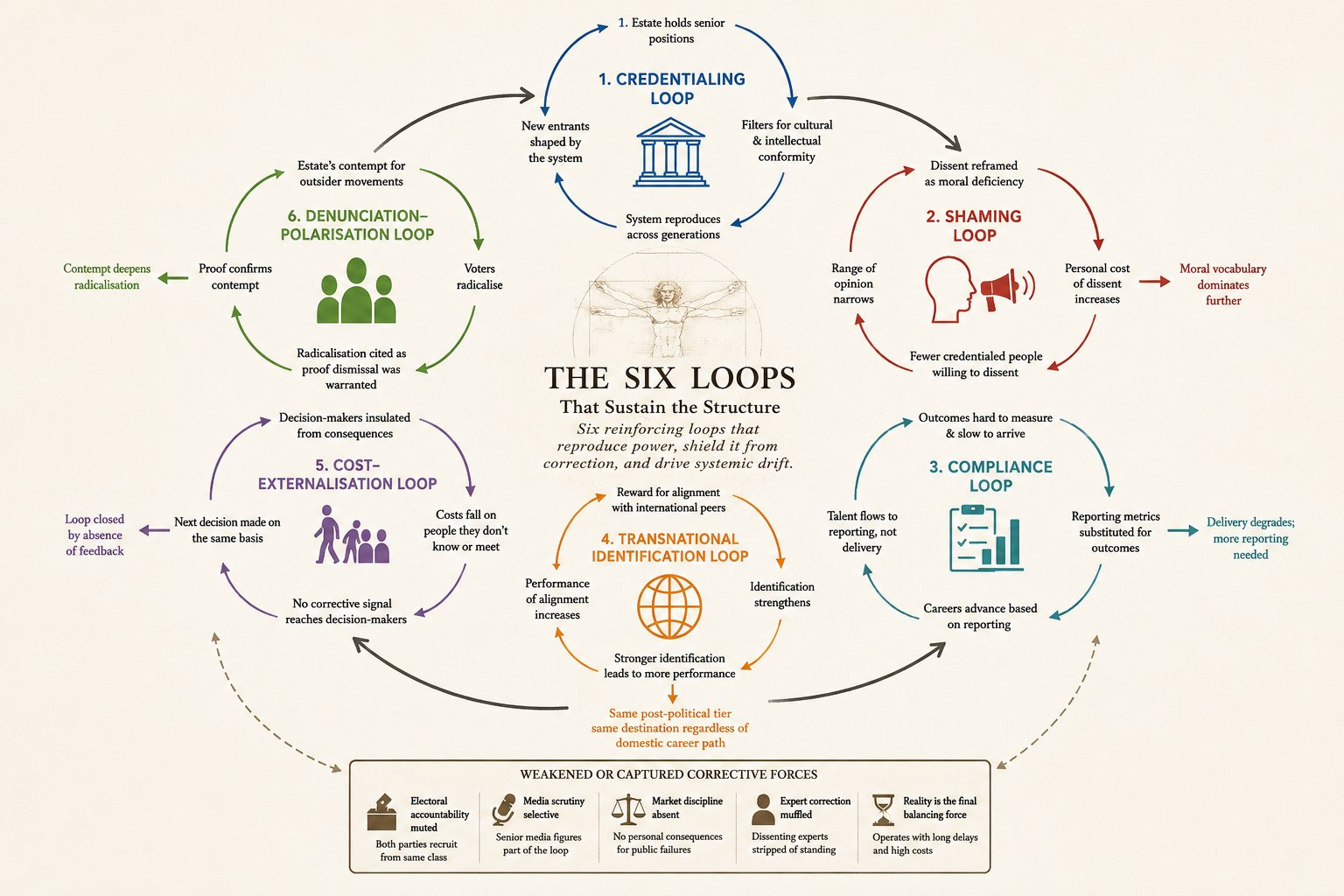
Six loops sustain the structure. They are worth naming because naming installs the lens, and once the lens is installed, the reader sees it everywhere without prompting.
The credentialing loop is the engine. The estate holds the senior positions that determine who is qualified to hold them. New entrants are filtered for cultural and intellectual conformity.
The system reproduces itself across generations without anyone needing to plan it. This is why elections change so little. Voters can replace the politicians; they cannot replace the credentialing system that supplies the politicians, advisers, regulators, and consultants. The replacement enters the same loop and emerges shaped by it.
The shaming loop is the immune system. Dissent is reframed as a moral deficiency, raising the personal cost of dissent, reducing the number of credentialed people willing to dissent publicly, narrowing the range of respectable opinion, making the moral vocabulary even more dominant, and further raising the cost of dissent. No one is forbidden from disagreeing. They are merely marked. The marking is the loop.
The compliance loop is the metabolism. When outcomes are hard to measure and slow to arrive, reporting metrics get substituted for outcomes. Careers advance based on reporting performance.
Talent flows into reporting rather than delivery. Actual delivery degrades. The worse delivery becomes, the more the system depends on reporting to conceal it, and the more reporting becomes the actual job. Every iteration of the loop weakens the connection between what the system says it is doing and what it is doing.
The transnational identification loop rewards estate members for performing alignment with international peers. The reward strengthens the identification. The identification strengthens the performance. The loop explains why senior figures across party lines exit into the same post-political tier, and why the destination is the same regardless of where the domestic career began.
The cost-externalisation loop insulates decision-makers from the consequences of their decisions. The costs fall on people whom the decision-makers do not know and rarely meet, so no corrective signal reaches the decision-makers, and the next decision is made on the same basis as the last. The loop is closed by absence, the absence of feedback from the people who bear the cost.
The denunciation-polarisation loop is the one closing around most people. The estate’s contempt for outsider movements radicalises the voters it dismisses. The radicalisation is then cited as proof that the dismissal was warranted. The proof confirms the contempt. The contempt deepens the radicalisation. This is the loop most likely to produce the rupture the historical examples warn against, and the estate cannot see it operating because seeing it would require granting standing to the people the loop is designed to deny.
The corrective forces that ought to balance these loops have been weakened or captured. Electoral accountability is muted because both major parties recruit from the same class. Media scrutiny is selective because most senior media figures are themselves part of the credentialing loop.
Market discipline is absent because public projects impose no personal consequences on the officials who approve them. Expert correction is muffled because dissenting experts are stripped of standing by the same loop that grants it. Reality remains the final balancing force, but it operates with long delays and exacts high costs, and by the time it asserts itself, the system has usually drifted past the point of incremental correction.
This is the key cognitive move. Once you see the loops, you stop asking why individual decisions are bad. You start asking which loop produced this decision and which other loops are protecting it from correction. The question of who is to blame becomes less interesting than the question of which feedback path has been cut. The diagnosis ceases to be moral and becomes structural, as the analysis requires, because the only escape from it is to see it; people get drawn into the loop themselves.
The missionary character
The shaming loop deserves a closer look, because it is the loop most invisible to the people running it.
The old clergy held its position by controlling the moral vocabulary of the society it ruled. To dissent from the Church was not merely to be wrong but to be wicked, heretic, infidel, fallen. The vocabulary did the policing. The Church didn’t need to enforce its monopoly through violence in most cases; the social cost of marking was enough. The loop ran on its own.
The Neo Liberal First Estate operates on identical lines, and the loop runs on its own in the same way. To question net zero is to be marked not as someone with a different reading of the evidence but as a climate denier.
To question mass immigration is to be marked not as someone worried about wages, housing, or social cohesion but as a racist.
To question the management of the pandemic was to be marked not as someone weighing costs and benefits but as a conspiracy theorist endangering grandmothers.
The pattern repeats across every contested issue because it is not a pattern of conscious decisions. It is a loop. The vocabulary is supplied by the credentialing institutions, deployed by the credentialed, enforced by social cost, and confirmed by the silence it produces. Each iteration strengthens the next.
The estate cannot see the loop operating because the loop’s operation is indistinguishable, from inside, from moral seriousness. The bishop who excommunicates a heretic does not experience himself as suppressing dissent; he experiences himself as defending truth.
The daughter who calls her parent a racist didn’t experience herself as installing a feedback mechanism; she experienced herself as raising consciousness. The loop is invisible to its operators because its operation is identical to their self-image. This is what makes it durable. It is also what makes it dangerous.
Net zero as a case study
Net zero is the clearest illustration of how the loops operate in concert, and the absurdity is structural rather than incidental.
Start with the accounting framework. It counts only what the estate wishes to count. Australia exports a vast share of its carbon through coal and gas shipped overseas, and none of that appears on the national ledger.
The carbon is burned in this system on a different planet than the one where it was dug up. The atmosphere doesn’t care where it’s burnt, but the estate does. But the framework has been drawn so that the export volume is somebody else’s problem. This is the compliance loop in pure form: reporting metrics have been substituted for outcomes, and the metric has been gerrymandered so that the reporting can succeed even when the outcome fails. Change the boundary, and the entire moral performance collapses, which is precisely why the boundary can’t be changed. When this is scaled, it creates a hidden rigidity that eventually destroys
Now add the shaming loop. Question the boundary, and you are a climate denier. The shaming loop protects the compliance loop from inspection. The two loops are running in tandem, each making the other harder to challenge.
Now add execution. Snowy 2.0 was sold to the public at $2.4 billion. Industry analysis now suggests figures as high as $40 billion, once transmission, firming, and delays are accounted for. Measured by cost per unit of electricity actually delivered, the project is among the worst infrastructure decisions in global history. No private board would have approved it. No private board would survive having approved it.
Inside the estate, the people who championed it have been promoted. This is the credentialing loop and the cost-externalisation loop working together: the people who approved the project are insulated from its consequences, and their careers advance through the same loop that produced the approval. There is no point in the system where a corrective signal can enter.
The NDIS tells the same story in a different domain. Originally costed at around $14 billion a year, it now tracks past $50 billion and is projected to exceed defence spending within the decade. A scheme designed to deliver dignity to disabled Australians has become a vast administrative ecosystem of providers, plan managers, consultants, and intermediaries, in which the cost per unit of actual care delivered keeps rising while outcomes remain contested.
To criticise the scheme is to be marked as someone who doesn’t care about the disabled. The shaming loop is again protecting the compliance loop, and the credentialing loop is staffing both with people who share the moral vocabulary that makes inspection impossible.
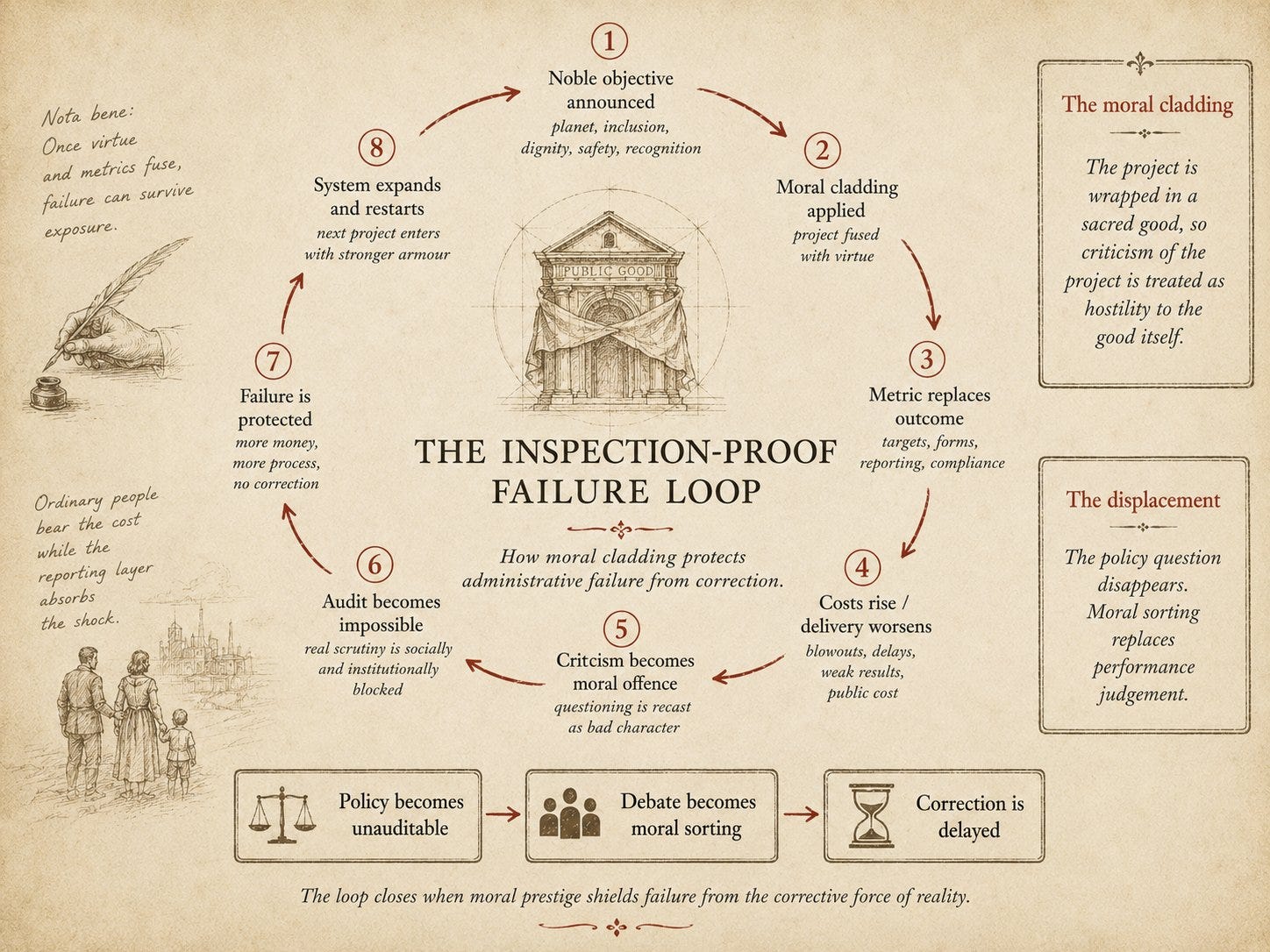
This is the trick. Every signature project of the estate is wrapped in a moral cladding that makes criticism of the project indistinguishable from opposition to the underlying good. Question net zero, you hate the planet. Question the NDIS, you hate the disabled. Question immigration levels, you hate foreigners. The cladding is the point. It is the shaming loop fused to the compliance loop. The project becomes unauditable because the audit itself has been pre-emptively criminalised. The loops have closed around the failure, making it inspection-proof.
It is not only Australia
The same loops are running in every comparable democracy, which is what tells us the phenomenon is structural rather than national.
Germany shut down its nuclear fleet on essentially theological grounds, replaced it with imported gas and reactivated lignite, and continues to lecture other countries on emissions while burning the dirtiest fuel on the continent.
The compliance loop has worked perfectly: the moral performance has succeeded even as the physical outcome has failed. Canada’s Trudeau government delivered a decade of a housing crisis, immigration mismanagement, and a productivity collapse, all defended throughout in the vocabulary of inclusion and progress.
The shaming loop has held the analysis at bay. The European Commission has constructed a regulatory architecture so vast and so removed from democratic accountability that its own member states now struggle to comply with it.
The cost-externalisation loop runs at a continental scale. The British civil service, the American administrative state, the World Health Organisation, the OECD, the proliferating ESG infrastructure — the same loops, the same outputs, the same protection from correction. The estate is transnational because the transnational identification loop has been running for thirty years.
In the UK, the shaming loop has failed completely, and now they simply imprison people en masse to ensure the compliance loop. Their crime is to question the dogma of the estate
The estate, fairly described
It is worth pausing to describe the estate as it understands itself, because the steelman matters and because the loops look different from inside.
The estate’s self-understanding isn’t cynical. Its members genuinely believe they are the essential responsible stewards of complex modernity. They have spent their adult lives acquiring the qualifications they regard as necessary to govern a complicated world.
They have watched, with real alarm, the rise of populist movements they associate with the catastrophes of the twentieth century. They believe, not always wrongly, that the policy positions they hold are supported by the weight of expert opinion in the relevant fields.
They believe, not always wrongly, that mass democratic preferences, untempered by technocratic discipline, would produce worse outcomes than the ones their administration produces. They believe, sometimes correctly, that some of the people who criticise them are indeed motivated by prejudice or ignorance.
From inside the loops, these are reasonable beliefs. The credentialing loop has provided members with credentials that genuinely represent expertise in a given field. The shaming loop has supplied them with a moral vocabulary that genuinely identifies some real bigots. The compliance loop has supplied them with reporting metrics that genuinely measure something. The transnational identification loop has supplied them with international peers whose company is genuinely stimulating. The cost-externalisation loop has provided them with genuinely comfortable lives. From the inside, the system looks like a meritocracy of decent people doing their best to solve difficult problems. The loops are invisible because they are the lens through which the members see.
The critique doesn’t require any of this to be false. It requires only that the estate’s confidence in its own judgement be disproportionate to its actual record, and that the loops that protect it from correction have become incompatible with the operation of democracy. Both propositions are demonstrable. The case studies that follow are the estate’s own.
The faces of the estate
Australian political life supplies the examples, and each example shows different loops operating in coordination.
Paul Keating, who as Treasurer and Prime Minister presided over the float of the dollar, financial deregulation, and the compulsory superannuation system that channelled the savings of ordinary Australians into a vast funds management industry, now sits on the international advisory council of the China Development Bank.
His statement of April 2026, attacking Angus Taylor’s immigration policy, is a near-laboratory specimen of the shaming loop in operation. Taylor’s proposal is not engaged on its merits. It is denounced as racism. The Liberal Party’s “default political policy” is declared to be racism. Howard is “Mr Racial Opportunism.” Hanson offers “dumb bigotry.” Voters concerned about immigration are not analysed but pathologised. Nowhere in the statement is the actual question permitted to surface: what level and composition of immigration serves the country, and who decides.
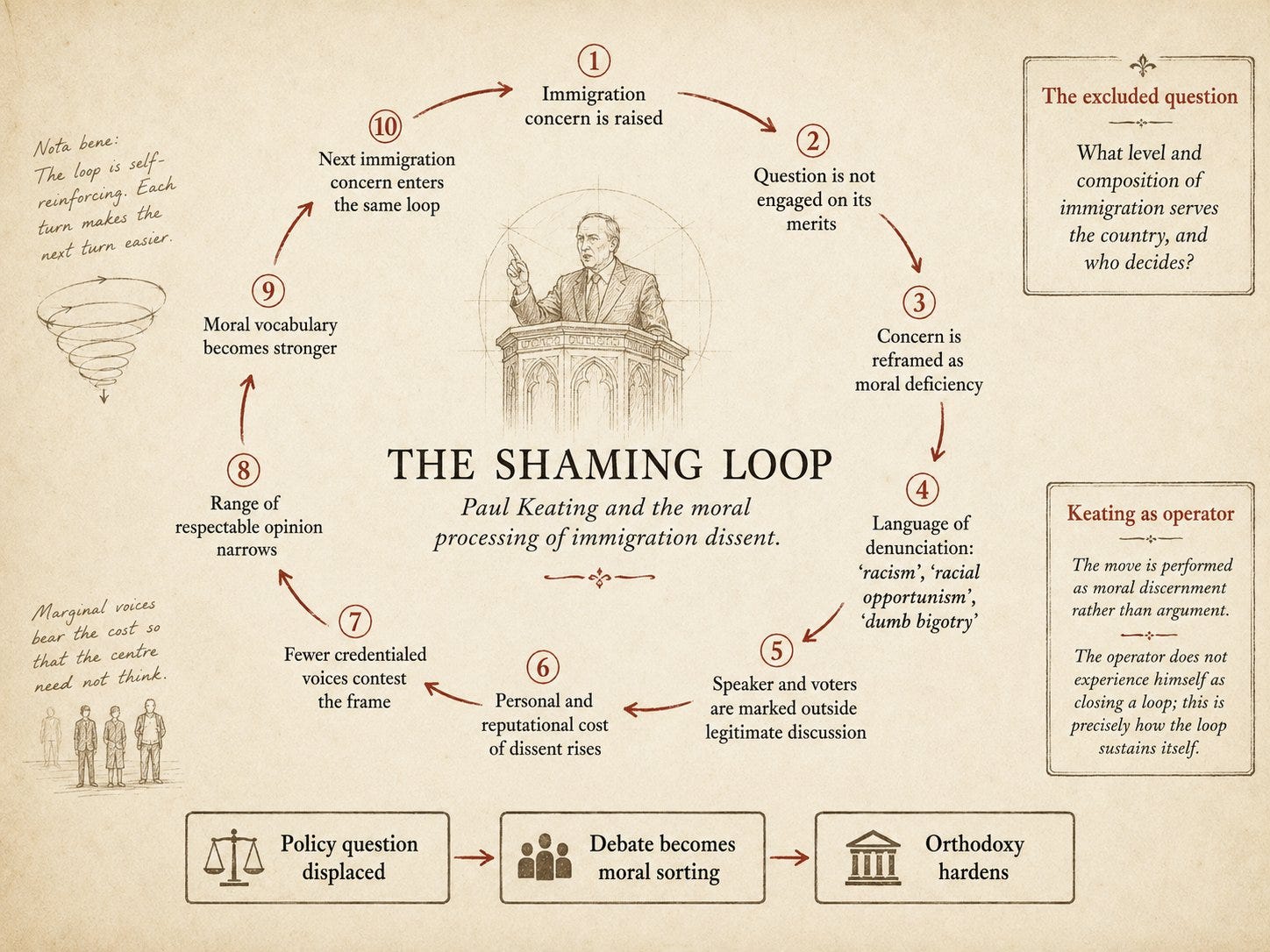
The function of the language is to close the shaming loop around Taylor and the voters he speaks to, marking both as outside the bounds of legitimate discussion. Keating performs the move with the fluency of a man who has spent forty years inside the loop and the bravado of one of the great master operators of the loop.
The nuance worth noting is that he does not experience himself as performing the move. He sees himself as a figure of rare intellectual discernment, a connoisseur of clocks and cabinets and grand strategy. The denied self is ecclesial. The bishop he will not admit to being is visible in every cadence, the pronouncement from the pulpit, the naming of heretics, the certainty that dissent is not error but sin. The shaming loop runs through him without his awareness, which is precisely how shaming loops run.
Malcolm Turnbull, a Goldman Sachs partner before politics, led a centre-right government while holding the cultural and climate positions of its opponents. His signature domestic project, the rebuilt National Broadband Network, became a textbook compliance-loop artefact: a multi-technology compromise that delivered outcomes widely judged inferior to the fibre-to-the-premises model it displaced, defended through process language rather than performance metrics. He was the Prime Minister who announced Snowy 2.0 at $2.4 billion, a project waved through on the strength of his own moral positioning, the grand renewable gesture that would secure his place in the climate-virtuous wing of history.
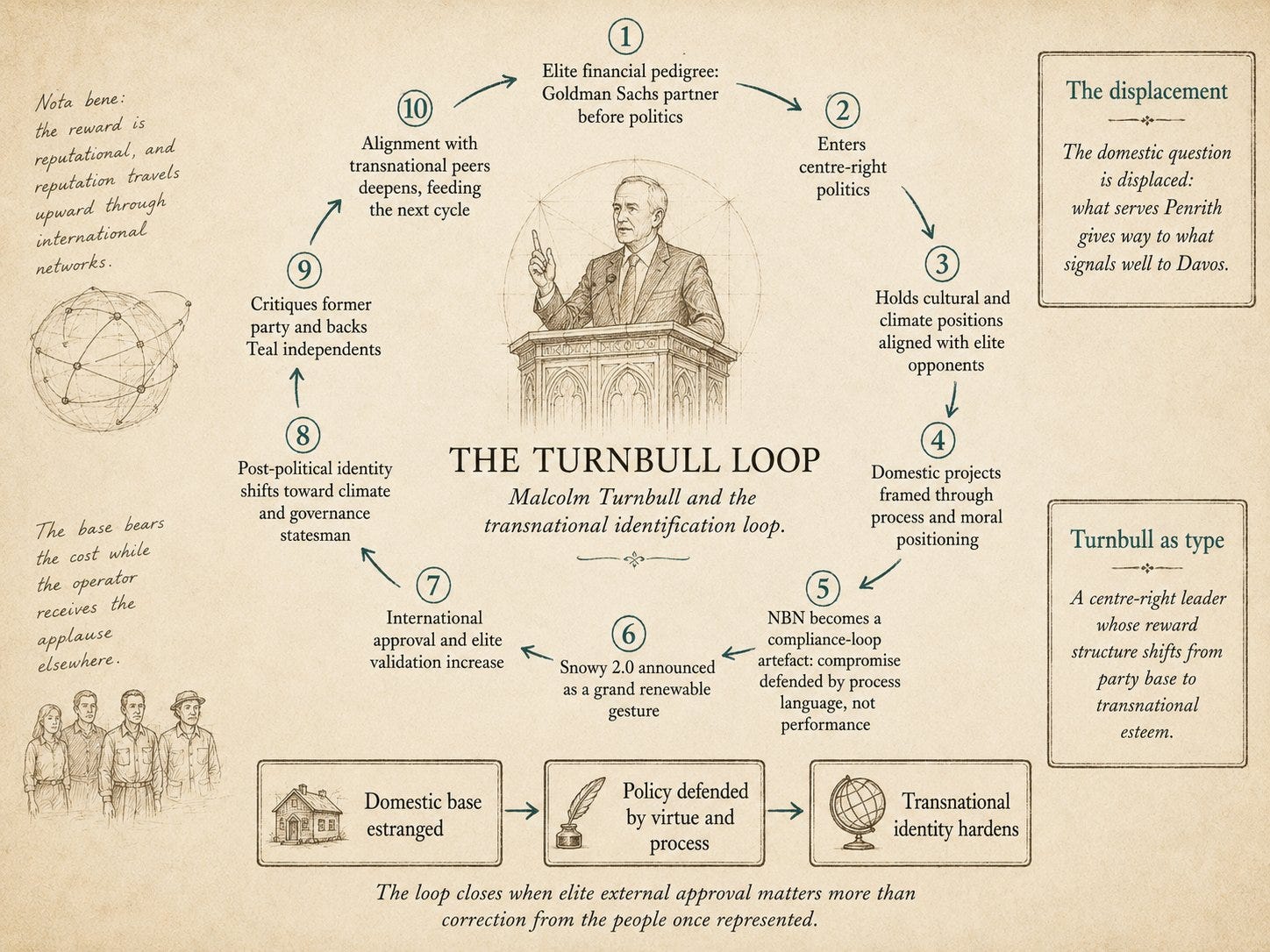
Since leaving office he has rebranded as an international voice on climate and governance, become a regular critic of his former party from platforms calibrated to Davos rather than to Penrith, and lent active support to the Teal independents, whose entire political proposition is the credentialing loop and the shaming loop fused into electoral form: affluent, credentialed, climate-righteous, and contemptuous of the Liberal base that once delivered him the prime ministership. Turnbull is the personification of the transnational identification loop.
Anthony Albanese governs in the same idiom. The signature commitments of his prime ministership, the Voice referendum, the 82 per cent renewables target by 2030, the AUKUS framework, and the expanding NDIS, are defined by announcement and moral framing rather than by delivery against measurable cost.
The Voice was prosecuted as a question of national character rather than of constitutional design, with opponents marked as the wrong sort of Australian.
When the public rejected it by a decisive margin in every state, the estate’s response was not reflection but lament for the electorate, the cost-externalisation loop denying that the verdict contained any information about the policy. Energy policy proceeds on targets the responsible market operator has repeatedly flagged as unlikely to be met on time or on budget, while the Prime Minister continues to announce them. The compliance loop runs. The NDIS, inherited but now firmly his to manage, tracks past $50 billion with no serious cost discipline in sight. The same loop runs there.
Scott Morrison supplies the Coalition’s contribution. In office, he governed by announcement and slogan while the actual machinery of government was being quietly restructured around him through the secret appointment of himself to five additional ministerial portfolios, a manoeuvre concealed from the parliament, the cabinet, and, in some cases, the ministers he was shadowing. The episode is instructive precisely because it was not corrupt in the conventional sense. No money changed hands. It was a procedural derangement: the Prime Minister acting as though the formal architecture of accountable government were an inconvenience to be circumvented. Since leaving politics, he has taken up advisory roles with American defence-industry-adjacent firms and joined the international speaking circuit.
The continuity of post-political destination across Labor and Coalition leaders is one of the most telling features of the estate. The transnational identification loop does not care which party supplied the credential.
These are not corrupt men in the cash-in-an-envelope sense. They are something more revealing. They are men in whom the loops have closed. Their identification, vocabulary, professional networks, and frame of reference sit comfortably inside the estate and uncomfortably outside it because every loop they live inside has reinforced that disposition. The same pattern is observable across the senior ranks of every major party in every comparable democracy. The party label is the costume. The loops are the substance.
Australia is not yet in full rupture. Resource wealth, federalism, and a still-functional private sector provide buffers that places like the UK or parts of Europe lack. Public backlash (One Nation shift, Voice rejection, Teal phenomenon) shows the polarisation loop is not fully closed. But the warning signs are there.
The deeper layer
It is worth noting that the estate is held in place not only by ideas and institutions but also by a way of life, and that way of life is itself a loop. The estate’s members marry late or not at all. They reproduce little, and increasingly through technological intervention. They raise their children within elaborate developmental infrastructures designed to funnel them into the credentialing loop of the next generation. They treat the body as a project and the family as a logistical problem. Their reproductive, professional, and political patterns are not three different things. They are one feedback system.
The estate is administratively deranged because it is, at a deeper level, disconnected from the inherited human practices, family formation, intergenerational continuity, physical work, religious participation, and embodied risk that produce the kind of judgment competent governance requires. People who have never built anything physical, never raised many children, never faced material consequences for being wrong, are now responsible for the construction, reproduction, and material survival of nations. The loops have selected the wrong people, and those wrong people are reproducing themselves within the loops.
What follows
It is tempting to close with a programme of reform. Rebuilding institutions around competence. Restoring outcome measurement. Raising the cost of denunciation. Reconnecting consequences to decisions. These are correct prescriptions in the sense that they would, in principle, weaken the reinforcing loops and strengthen the balancing ones. They won’t be implemented, because the estate that would have to implement them is the estate that benefits from their absence. The loops protect themselves from the interventions that would dissolve them. That is what loops do.
The honest analysis is harder. Systems of this kind do not reform. They exhaust themselves. The reinforcing loops continue to run, the balancing loops remain weak or captured, and the dysfunction accumulates beneath the reporting layer until an event arrives that the moral vocabulary cannot narrate away. At that point, the system doesn’t adjust. It ruptures. The loops break, all at once, and the legitimacy they were generating disappears overnight.
What comes after is not necessarily better. The Ancien Régime gave way to the Terror before it gave way to Napoleon, and Napoleon gave way to a century of European convulsion. The late Western Roman administration gave way to seven centuries in which the lights were largely out. The Bronze Age palaces gave way to a dark age from which writing itself did not recover for four hundred years. Post-estate orders emerge, often violently, from the wreckage of the legitimacy the previous order squandered, and they are shaped by whoever has the energy and the conviction to fill the vacuum. Sometimes, that is better for people. Often it is not.
The question is therefore not how to reform the estate but how to prepare for its exhaustion in ways that maximise the chance that what replaces it is decent.
That means building parallel loops now , alternative credentialing systems, alternative media, alternative professional networks, alternative local economies, alternative civic and religious associations, that can carry the practices of competent self-government through the rupture and out the other side.
It means cultivating the habits and the confidence that allow ordinary people to run their own affairs without estate supervision, so that the post-estate order has competent operators waiting when it arrives. It means refusing the moral vocabulary while it is still costly to refuse it, breaking the shaming loop one conversation at a time, so that when the system ruptures, the refusal does not have to be invented from scratch. It means accepting that the work is generational and that those who do it will not see it through to completion.
The estate sees none of this. The estate cannot see it, because the loops that constitute the estate are the same loops that prevent the estate from seeing itself.
The bishop cannot see that he is a bishop. The credentialing system cannot see that it is reproducing itself rather than producing competence. The compliance system cannot see that the metric has replaced the mission. Each loop is invisible to its operators because the operators are inside the loop. The historical record is unanimous on what comes next.
They are all taken utterly by surprise when the whole rotten edifice finally collapses. This astonishment has nothing to do with clinical insanity. No, they are not mad in any medical sense. They are instead a separate and self-perpetuating estate lodged within the state, a clerisy of good samaritans that doesn’t merely seek to advise the state but to govern it outright in its own image, and they are, to put the matter with the bluntness it deserves, administratively deranged.
Awesome essay, Craig. We must have another chat sometime. Keep up the great work. Best regards from the loopy UK.
And describes hypernormalisation of terminal Soviet state, which suffered decades of dysfunction before the facade fell. Great read. 🙏