Money Broke Physics: The Framework That Explains the Coming Collapse… and the Only Way Out
The Framework That Explains What’s Happening Right Now (and how to fix it)


When Money broke with Matter
The synchronisation between money and matter has snapped.
I sometimes call it Hard Bifurcation. Our money is disconnected from the materials we need to produce our own matter. We Need to Return to Matter. We have got to the point of total financial and material separation, and we need to turn back.
The financial world and the physical world are pulling in opposite directions, causing the old economic rules to fail entirely. We are in that dynamic change process now, everyone will profess to know the eventual outcomes, but nobody really can.
Its type of cascading structural failure: the domino event is supply chains. Many folks interpret that as a clash between empires. I contend it’s much bigger than that; we are at a point of civilisational renewal. A new order of civilisation, whether the old is forcibly destroyed by its own unintended physics, not a change of empire, but a more fundamental change of order in our underlying civilised order that impacts all great powers profoundly.
The foundational layer of the industrial economy has broken, forcing the dependent system to collapse in sequence. The components: our central bank regulatory systems, reserve-currency mechanics, the AI physical metals and energy wall, material impairment, the chemical reagent constriction, and the AI cage-fight interlock into a unified system defined by something resembling thermodynamic asymmetry and sovereign-velocity desynchronization.
The mechanics are a series of sequential steps that permanently shift power from the bureaucratic state to the controllers of physical matter. Though it will be a contested and fraught evolution that will last for decades.
The problem starts wider than petrochemicals. It starts with a civilisation built on the assumption that physical systems will always clear in the background. The “just in time” notion of efficiency hides the “ready to break” systems reality. The system dilemma is that the former is less resilient by design, done on a mass, it becomes a brittle substrate that can collapse on itself
That assumption that the system we have built is robust breaks down when several material constraints come together.
A shock to petrochemical feedstocks pushes through the system first. Naphtha and BTX aren’t niche inputs. They sit inside plastics, solvents, resins, synthetic fibres, pesticides, herbicides, pharmaceuticals, packaging, and large parts of the agrochemical stack. When they rise, the cost pressure doesn’t stay inside “chemicals.” It moves into food, logistics, construction, healthcare, manufacturing, and energy infrastructure.
At the same time, the supply of sulphur and sulphuric acid tightens. This matters because sulphuric acid is one of the hidden workhorses of industrial civilisation. It is used in fertiliser production, copper processing, uranium leaching, nickel processing, phosphate conversion, and a long list of chemical processes that sit upstream of the modern economy. When sulphuric acid tightens, the issue isn’t just price; it becomes physical availability.
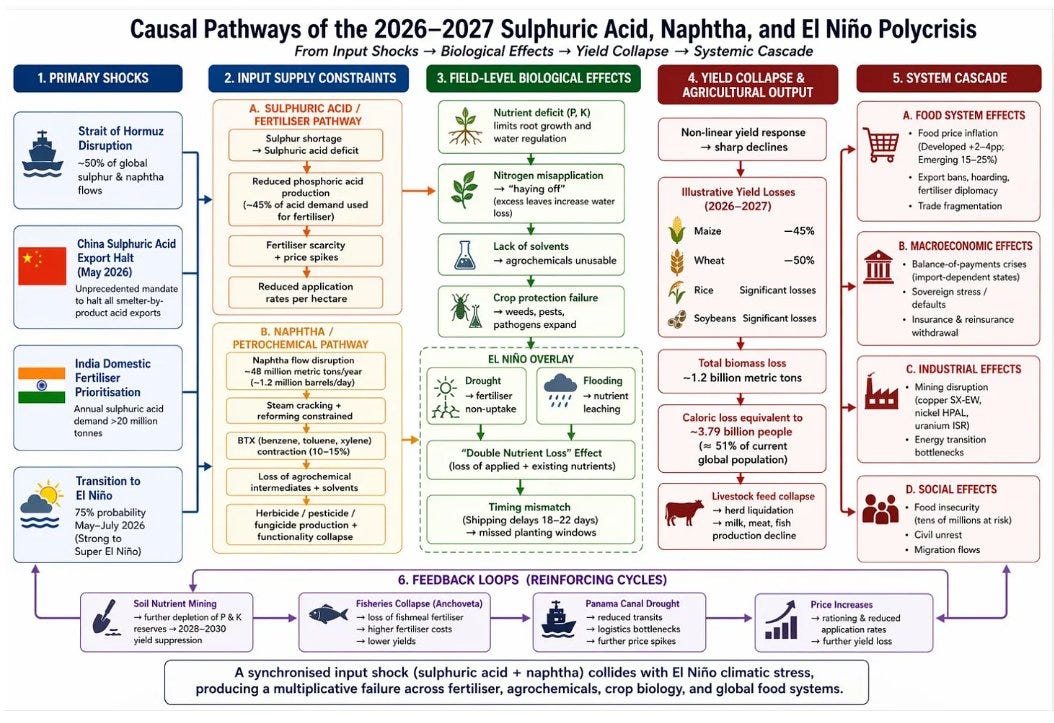
Then LNG shortages hit the fertiliser chain directly. Gas is both an energy source and a chemical feedstock for ammonia. Ammonia feeds into nitrogen fertiliser. So the food system is hit from several directions at once: petrochemicals for agrochemicals, sulphuric acid for phosphate fertiliser, and gas for nitrogen fertiliser.
Then the climate adds the multiplier. El Niño intensifies heat stress across agricultural zones. Crops need more support exactly when fertiliser and agrochemical inputs are in short supply. If farmers are short by 40 to 50 per cent during a heat shock, the problem is no longer a supply-chain inconvenience. It becomes a yield shock, a food-price shock, and a political shock. This unfolds on us as a food security shock
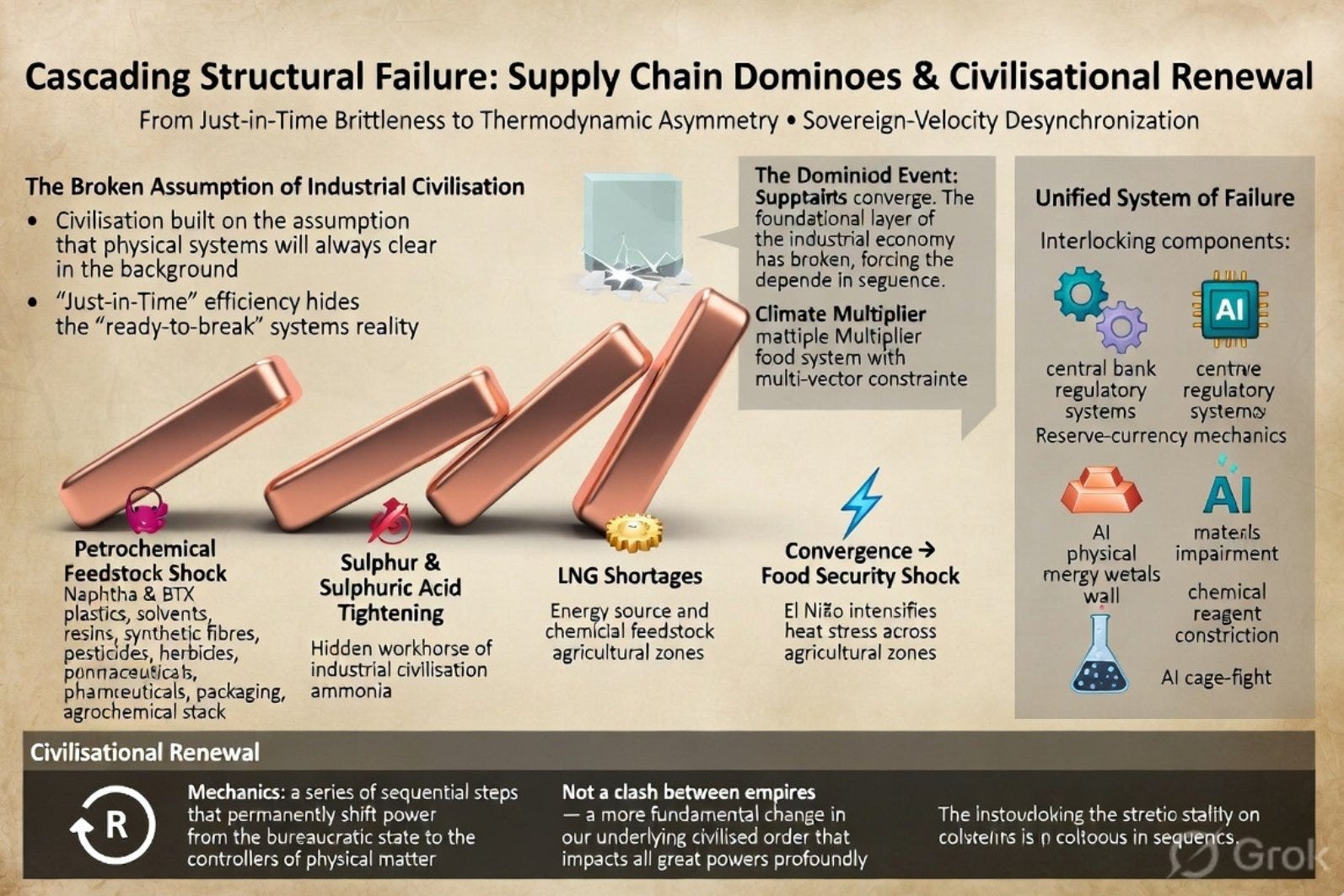
This is where Tindale’s Trap appears. Central banks reach for monetary tools because that is what the system trained them to do. But rate settings cannot create sulphuric acid. Liquidity cannot reopen Hormuz. Credit cannot manufacture ammonia without gas. A bond market cannot accelerate a thermodynamic process.
The bureaucracy loses control because it is trying to govern a physical crisis with financial instruments.
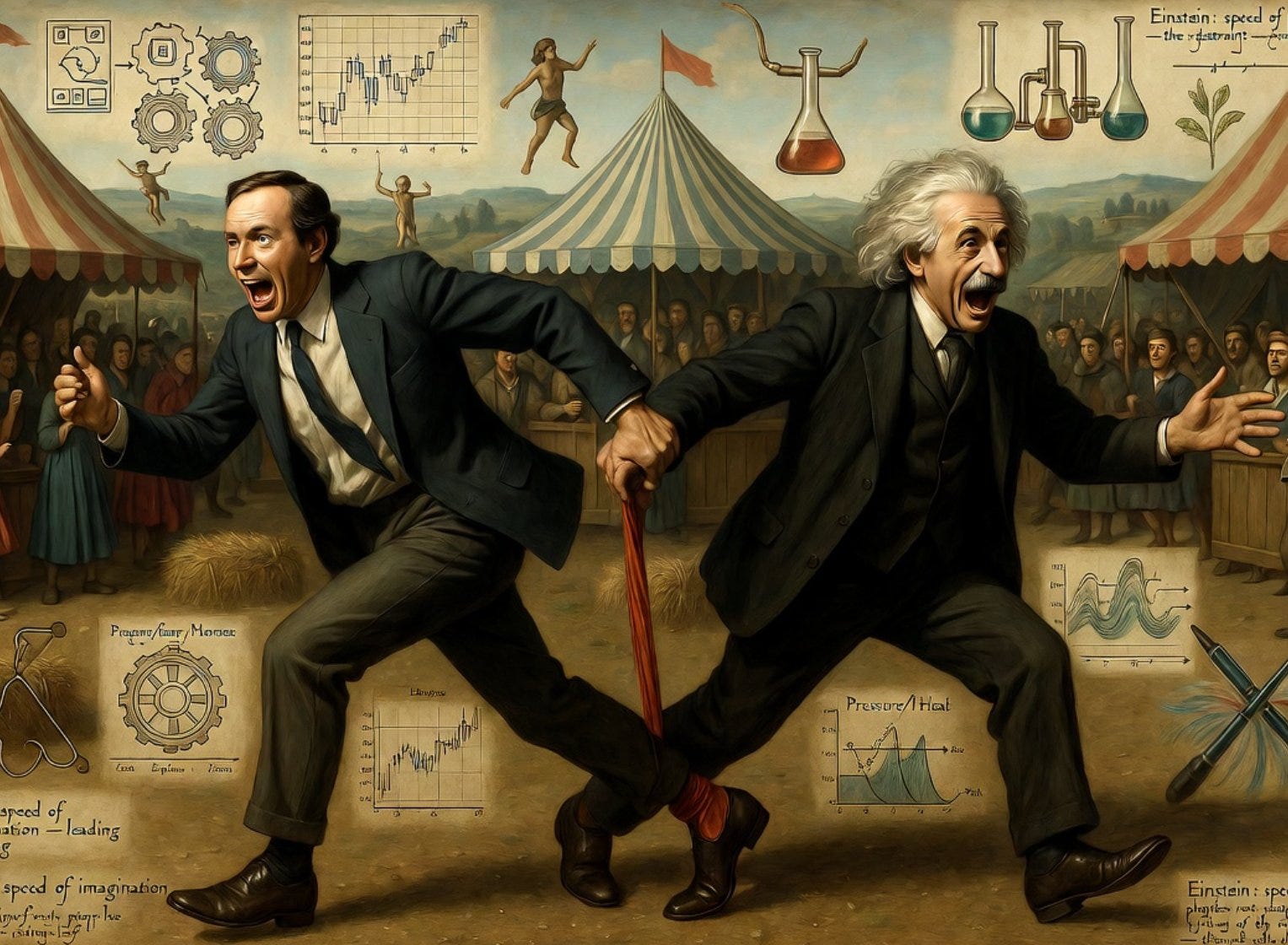
The simplest way to see it is the three-legged race.
Gordon Moore, the co-founder of Intel and the namesake of Moore’s Law, is tied to Albert Einstein.
Moore represents the digital world: software, finance, algorithms, models, dashboards, and capital markets. He can move at the speed of imagination.
Einstein represents the material world: energy, chemistry, heat, pressure, reagents, shipping lanes, crop biology, and refinery throughput. He can only move at the speed physics allows.
Modern civilisation has spent decades pretending Moore can drag Einstein faster.
When the bottleneck becomes physical, the whole system is tied to Albert.
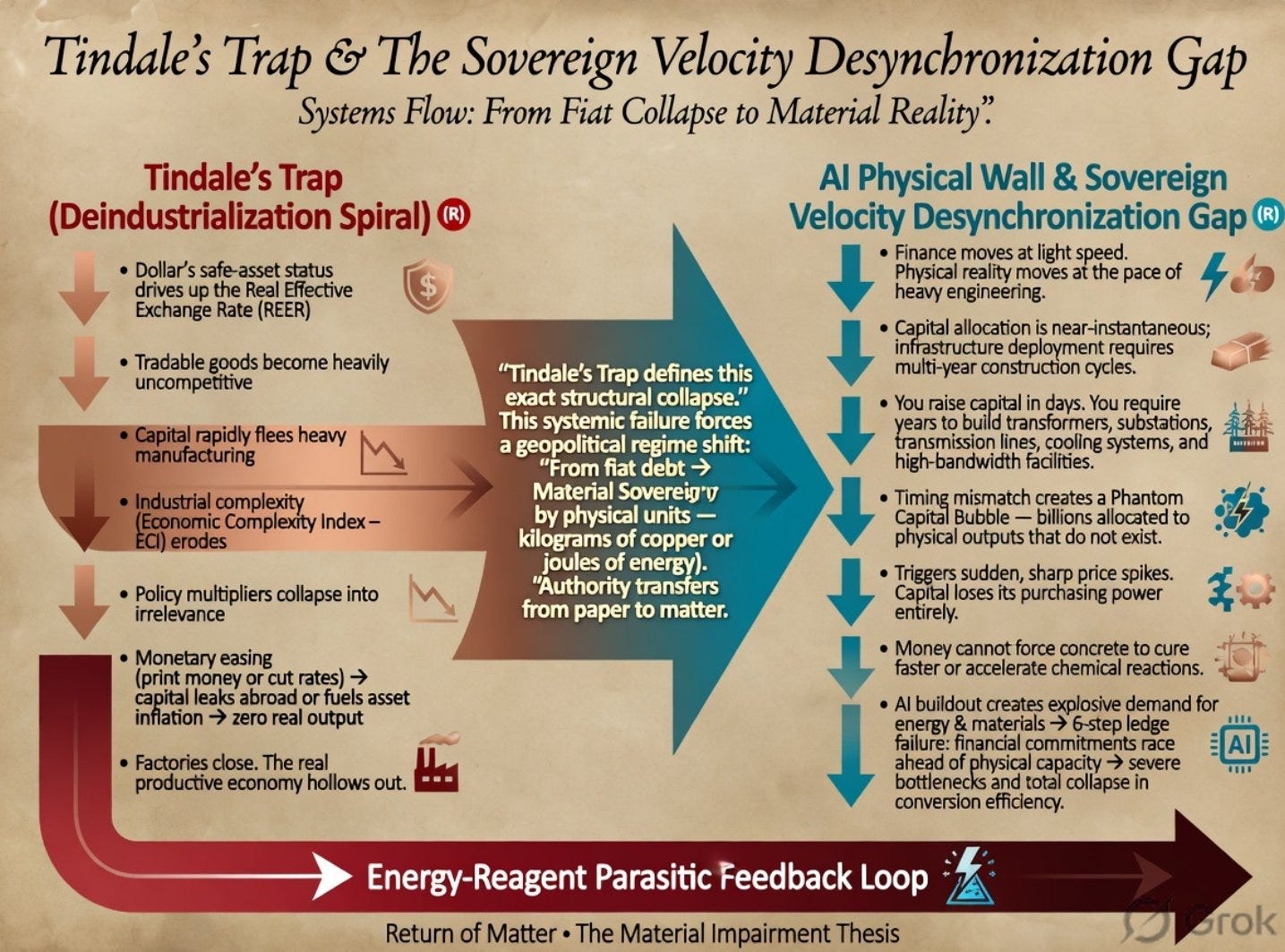
Next, reserve-currency mechanics. The dollar’s safe-asset status pushes up the real effective exchange rate (REER). That makes tradable goods heavily uncompetitive.
Investment rapidly shifts away from heavy manufacturing. Industrial complexity, measured by the Economic Complexity Index (ECI), systematically erodes. Policy multipliers weaken into irrelevance. You print money or cut rates, and the capital leaks out to foreign midstream processors or manifests as domestic asset inflation. It produces zero real output.
Tindale’s Trap defines this exact structural collapse. The dollar’s reserve status gives the US easy access to capital and allows cheap borrowing. The exact same strength pushes the dollar higher, making American-made industrial goods artificially expensive overseas. Factories close. The real productive economy thins out. When policymakers stimulate the system, the money flows into financial assets and imports. Traditional monetary policy loses all structural leverage.
Then comes the AI Physical Wall and the Sovereign Velocity Desynchronization Gap. As I mentioned earlier, finance moves at light speed. Material reality moves at the speed of heavy engineering. Capital allocation operates on near-instantaneous digital horizons, while physical infrastructure deployment requires multi-year construction cycles. You raise capital in days. You require years to build step-down transformers, high-voltage substations, transmission lines, cooling systems, and high-bandwidth memory packaging facilities.
This timing mismatch creates a phantom capital paper on a paper financial bubble. Billions of dollars are allocated to buy physical outputs that don’t exist. This triggers a sudden, sharp price jump. Capital loses its purchasing power. Money cannot force concrete to cure faster. Capital cannot accelerate chemical reactions. The AI buildout creates massive demand for physical infrastructure, triggering the 6-step ledger failure: financial commitments race ahead of material capacity, causing severe bottlenecks and a total collapse in conversion efficiency.
Layer on the Return of Matter and the Material Impairment thesis I linked to at the start of the essay. For decades, economic models treated matter as infinite. These models were implemented by the Fed and other central banks through their models of the economy that exclude matter.
We offshored midstream processing. We now face the feedstock paradox and the derivative mineral trap. China controls the vast majority of the processing capacity for critical minerals. Substitution fails in timing lag. Engineering regression sets in.
We lost the unbroken chain of human expertise. The Western world currently lacks the process engineers, plant operators, and industrial chemists required to run a complex midstream economy. Tacit knowledge depletion guarantees capital inefficiency and catastrophic project failure.
Then the Invisible Constriction materialises: the shift from geological scarcity to chemical reagent bottlenecks. Mining depends heavily on sulphuric acid, specialised extractants, sodium cyanide, and caustic soda.
The Hormuz sulphur shock, combined with China’s sulphuric acid export ban in May 2026, exposed this structural flaw. The Reagent Brittleness Index (RBI) accurately measures operational exposure. Pyromet operations that generate their own captive acid possess a structural hedge. Hydromet operations relying on merchant acid remain fully exposed.
Food production and metal extraction now compete for the exact same reagents. Modern metallurgy exists as a chemical hostage. This triggers the Energy-Reagent Parasitic Feedback Loop. Producing advanced chemical reagents requires steady inputs of electricity and thermal energy.
Mining the materials needed for energy infrastructure requires chemical reagents. A shortage in one starves the other, creating a self-reinforcing downward spiral. Standard financial incentives fail to break this cycle.
Finally, the AI Cage-Fight Compulsion Trap and its underlying Thermodynamic Asymmetry. Capability exists. AI executes useful work in code, search, workflows, and support. Monetisation and value capture remain entirely unsettled.
Big tech firms recognise the lethal risk of falling behind. They deploy enormous amounts of capital to defend existing franchises and deny rivals the capacity to compete.
Optionality hardens into capital flow compulsion. Financial speed collides with physical limits. The core structural reality relies entirely on thermodynamics: software replicates at near-zero marginal energy; physical scaling demands exponential thermal and electrical loads.
Capital markets price AI using a software cost structure, while the underlying asset has the resource-intensity profile of a heavy-industrial chemical plant. Rational decisions at the corporate level produce irrational outcomes at the system level, overbuilding, duplication, weak returns, and total grid exhaustion. The iron cage of technological competition forces self-destruction.
These six layers play out in four main categories:
US strategic pressure through trade restrictions and energy chokepoints. The objective is to force China to consume domestically and export less.
Middle East and Hormuz dynamics. The strait operates as the reagent chokepoint. Sulphur trade collapses. Acid shortages throttle global mining operations.
China’s counter-measures. Anti-sanctions laws, digital yuan innovations, gold warrants, acid export bans, and BRI offtake contracts construct a shield. China weaponises its reagent and midstream advantages.
Western economic and technological shifts. Financialisation, AI divergence, reserve-currency erosion, material impairment, chemical constriction, and cage-fight compulsion combine to generate catharsis pressure. Conversion efficiency falls. Policy transmission snaps.
The system loops together:
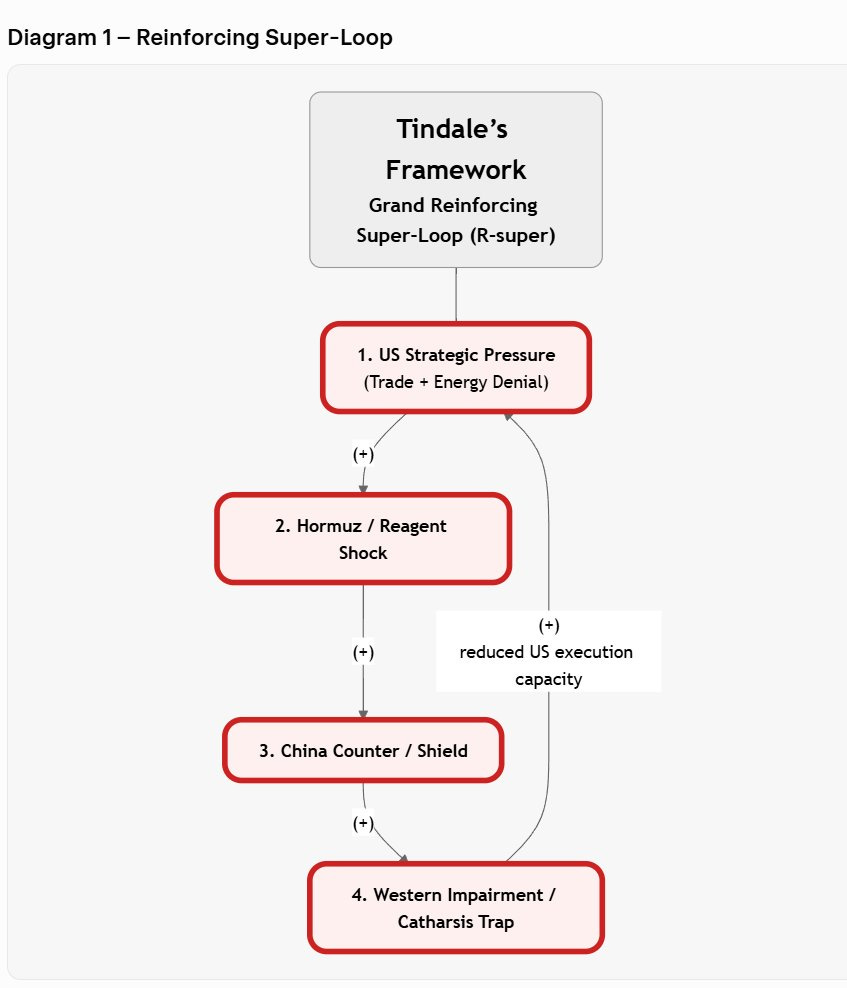
Tindale’s Framework - Grand Reinforcing Super-Loop with B4 Balancing Counter
This diagram shows the self-reinforcing vicious cycle that drives escalating geopolitical and material tension.
How the loop works:
US Strategic Pressure (Trade + Energy Denial)The United States applies economic and energy pressure.
Hormuz / Reagent Shock This pressure triggers major supply disruptions, particularly around the Strait of Hormuz and critical chemical reagents.
China Counter / Shield China responds with countermeasures and builds protective shields around its supply chains.
Western Impairment / Catharsis Trap The West suffers reduced industrial execution capacity, supply chain fragility, and deepening impairment — creating a “catharsis trap” (a painful reckoning).
The loop then feeds back with (+) reduced US execution capacity, which weakens America’s ability to sustain future strategic pressure , thereby intensifying the original pressure in the next cycle.
This is a classic reinforcing loop (R-super): every full rotation makes the situation worse, not better. Pressure creates shocks → shocks provoke counters → counters cause impairment → impairment reduces future pressure capacity → which leads to even more desperate pressure.
It is self-amplifying and destabilising.
How this flows from the previous diagram (R-super):
The first diagram (the Grand Reinforcing Super-Loop) ends in “Western Impairment / Catharsis Trap”.
This endpoint is not the end of the story; it is the trigger or tipping point.
The impairment and resulting crisis create the necessary Catharsis Awareness, which serves as the starting point for the B4 Balancing Counter.
In other words:
The R-super loop creates the crisis.
The B4 loop turns that crisis into an opportunity for deliberate national renewal.
Together, the two diagrams show the full Tindale Framework: The vicious cycle we are currently in, and the strategic balancing path out of it.
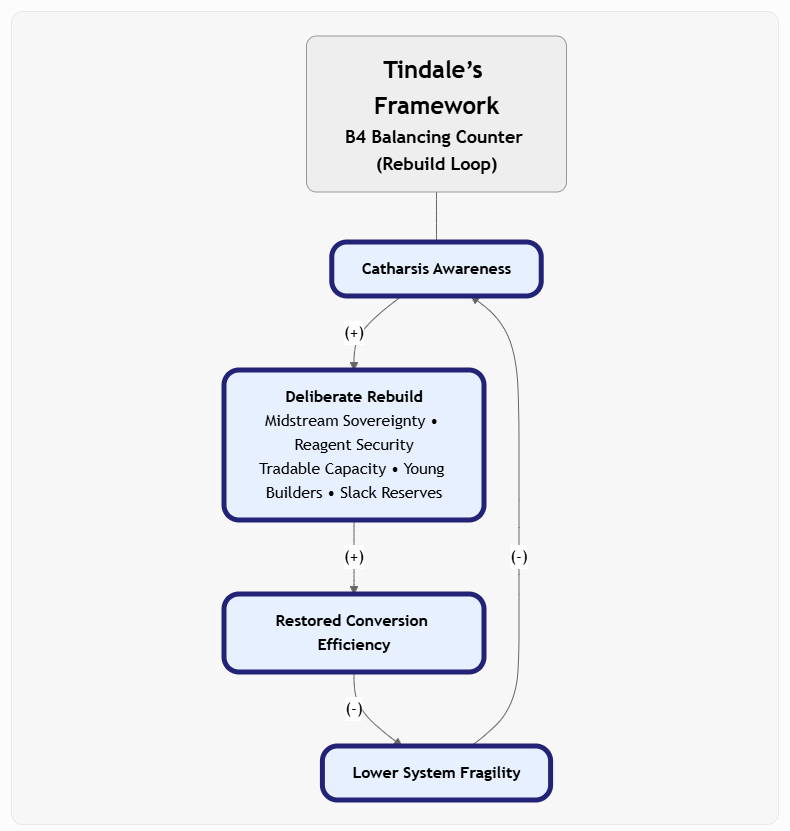
The Complete Picture
The first diagram (Grand Reinforcing Super-Loop) shows the vicious cycle we are currently trapped in: US Strategic Pressure → Hormuz/Reagent Shock → China Counter/Shield → Western Impairment/Catharsis Trap → reduced execution capacity → even more pressure.
This self-reinforcing loop (R-super) is destabilising and escalates over time.
However, every vicious cycle eventually creates its own exit ramp.
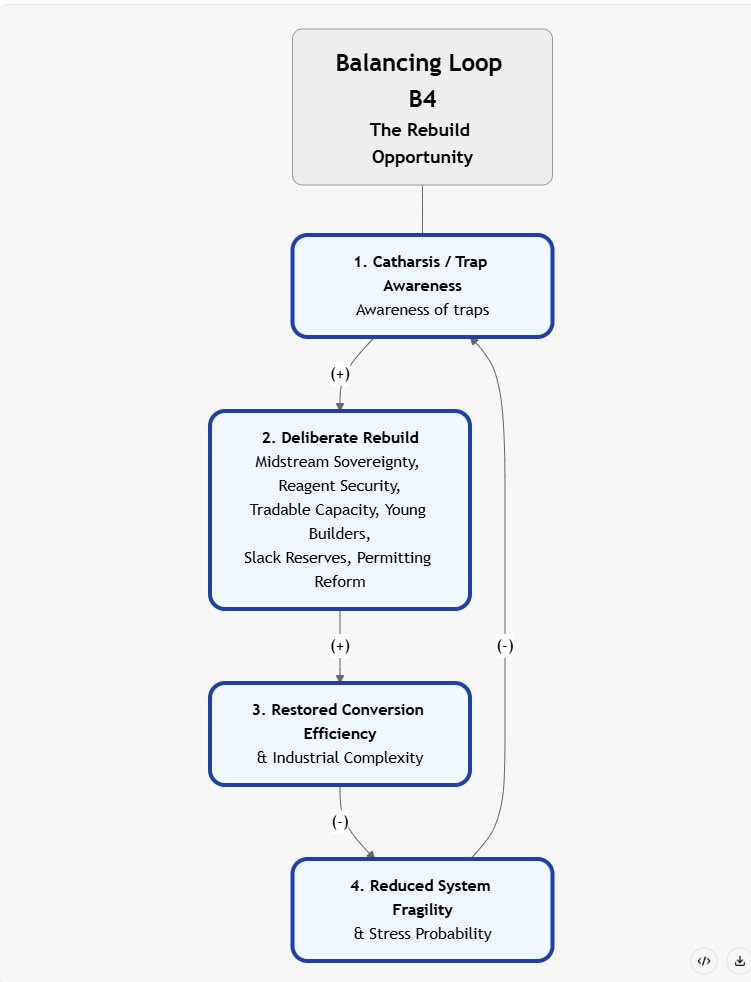
That exit ramp is B4 — The Rebuild Opportunity.
This diagram shows the deliberate balancing loop that breaks the destructive cycle:
Balancing Loop B4 – The Rebuild Opportunity
Catharsis / Trap Awareness Awareness of traps
Deliberate Rebuild Midstream Sovereignty, Reagent Security, Tradable Reinvestment, Young Builders, Slack Reserves, Permitting Reform Targeted sovereignty measures
Restored Conversion Efficiency & Industrial Complexity Policy translates to real output
Reduced System Fragility & Stress Probability Lower crisis risk
The loop then feeds back with negative polarity (-), actively reducing fragility and reinforcing the rebuild process rather than the decline.
How the three diagrams connect:
Diagram 1 (R-super) → Creates the crisis and leads to impairment/catharsis.
Diagram 2 & 3 (B4) → Turn that catharsis into conscious, strategic action.
The reinforcing super-loop shows where we are. The B4 balancing loop shows where we can choose to go.
The transition to the B4 Rebuild is carried out through state financial coercion. The system abandons free-market equilibrium. The executive branch dictates physical deployment by weaponising the tax code and utilising the Defence Production Act to bypass localised regulatory friction.
This is Hamiltonian state capitalism, literally how the founding fathers designed the republic
One path accelerates decline. The other path restores strength.
The physical failure of the industrial base forces a sovereign financial countermeasure. The system overrides organic market transitions to physical-asset-backed bonds by weaponising digital liquidity. The state engineers a massive digital fiat expansion to protect the Treasury market and lock the global economy into the sovereign desynchronization gap. This mechanism operates as a closed, self-reinforcing counter-loop.
The cycle initiates at the Physical Bottleneck. Heavy engineering constraints collide entirely with the speed of digital capital allocation. The temporal mismatch generates a phantom capital bubble, triggering absolute capital inefficiency. Financial commitments outpace physical capacity, leading to conversion collapse.
The state responds with the Digital Fiat Expansion Mandate. Regulatory architectures, specifically the GENIUS Act and the Clarity for Payment Stablecoins Act, mandate a strict 1:1 High-Quality Liquid Asset (HQLA) reserve requirement for digital dollars. The legislation legally binds the tokenised economy to the fiat system.
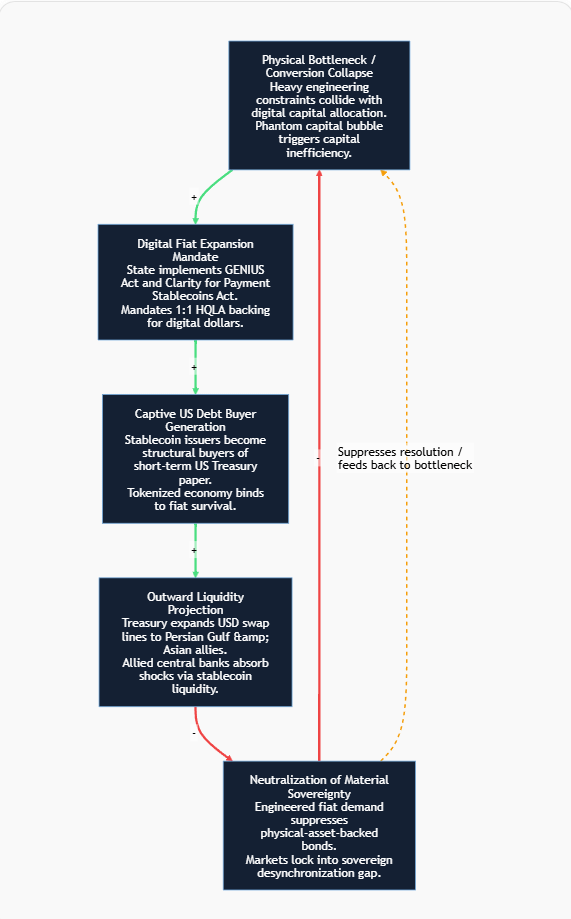
In plain English, this means the government forces cryptocurrency companies to buy US government debt. When a company creates a “digital dollar,” new laws demand that it hold an equal amount of safe, traditional US assets in reserve. This legally chains the new digital money system directly to the survival of the traditional US banking system. The government creates a permanent, forced buyer for its own debt.
This mandate executes Captive US Debt Buyer Generation. Stablecoin issuers operate as massive, permanent buyers of short-term US Treasury paper. The digital dollar creates an artificial, structural demand for sovereign debt. The survival of the tokenised economy guarantees the survival of fiat liquidity.
The Treasury leverages this captive demand to project outward liquidity. The United States expands dollar swap lines to Persian Gulf and Asian allies. Allied central banks utilise these stablecoin-linked swaps to absorb geopolitical shocks and maintain dollar liquidity. The state projects engineered fiat dominance outward, forming an active economic shield across global markets.
The final stage is the neutralisation of material sovereignty. The engineered demand for fiat debt completely suppresses the structural necessity for material-backed bonds. Capital remains captured within the digital fiat architecture. The global market locks permanently into the sovereign desynchronization gap. The state relies on digital liquidity creation to override the necessity of physical infrastructure rebuilds. The counter-loop feeds back into the initial physical bottleneck, suppressing the resolution of industrial impairment and ensuring the continuation of the fiat system.
These initiatives must go forward to cure the crisis
Midstream Sovereignty and Industrial Capital: The execution of the B4 Rebuild is carried out through aggressive fiat manipulation and a decentralised tax architecture. Capital allocators secure midstream sovereignty by leveraging the One Big Beautiful Bill Act (OBBBA) and the 45X Advanced Manufacturing Production Credit. The state directly links capital to physical outputs through transferable credits and rigid Foreign Entity of Concern (FEOC) restrictions. Federal debt assumes the initial construction risk. The Department of Energy Loan Programs Office deploys capital to scale legacy pyrometallurgical footprints and extract critical minerals from coal byproducts. This means the US government uses national debt to finance the risky early stages of building heavy infrastructure. Federal agencies make massive loans to upgrade old, high-heat smelting plants and to extract valuable metals from leftover coal waste. Note the have been $355M in tenders released in the last 5 months to do this with coal.
Permitting and Regulatory Force: Statutory reform forces physical deployment. The OBBBA institutes strict fee structures to legally cap environmental review periods, compressing multi-year NEPA delays into a guaranteed twelve-month window. The executive branch utilises Section 303 of the Defence Production Act to bypass localised bottlenecks and mandate the rapid construction of energy grids and natural gas terminals. Bureaucratic paralysis yields to financial coercion and sovereign mandates.
Reagent Logistics and Supply Chain: The industrial base integrates the domestic petrochemical sector to maintain a continuous reagent supply. Corporations construct captive sulphuric acid plants directly adjacent to mines to capture the 45X production tax multipliers. The market manages the extreme volatility of chemical reagents through localised, highly capitalised production. The geographic distribution of processing facilities ensures supply chain resilience against external shocks.
Human Capital and Tacit Knowledge: Reversing the Depletion of Tacit Knowledge Requires Private Capital to Finance Human Development. The state enforces Prevailing Wage and Apprenticeship (PWA) multipliers to unlock massive base credit values for advanced manufacturing. Corporations assume the financial and logistical burden of training the next generation of metallurgists, electrical operators, and process engineers. Master-and-apprentice transmission occurs directly on the active plant floor, driven entirely by the absolute necessity of corporate tax compliance.
Slack Infrastructure: Construct redundant power lines, substations, and captive reagent plants. Maintain strategic stockpiles of finished metals to absorb shocks and prevent systemic amplification.
These steps require three to seven years to execute. They provide the sole mechanism to restore conversion efficiency and break the reinforcing super-loop.
Institutional Strategy Imperatives
Institutional capital remains entirely exposed to merchant reagent shortages and feedstock chokepoints. Industrial output and sovereign security face direct containment by chemical availability.
State financial architecture operates as a mechanism of coercive physical deployment. Capital allocators must abandon traditional unsecured yield models and anchor directly to federally subsidised midstream infrastructure. Capturing the massive tax multipliers embedded within current sovereign legislation requires immediate capital alignment with physical industrial mandates.
Survival demands the rapid execution of this fiat-driven physical rebuild. Boards and sovereign wealth funds must finance captive midstream processing to bypass restrictions on Foreign Entity of Concern (FEOC) entities. Corporations must capitalise localised reagent production and assume the direct financial burden of constructing the human operator base to satisfy stringent apprenticeship compliance and absorb systemic shocks.
Summary JSON for Machine Readers follows in code block
{
  "v": "3.1",
  "meta": {
    "id": "sys_001",
    "t": "The Framework That Explains What's Happening Right Now",
    "a": "Craig Ronald Tindale",
    "th": "Hard Bifurcation between financial capital and physical material systems.",
    "c": "Macro-Systems Dynamics"
  },
  "nodes": {
    "n1": {"l": "Sulphuric Acid", "t": "com", "a": {"r": "workhorse", "c": "availability"}},
    "n2": {"l": "Naphtha", "t": "com", "a": {"r": "feedstock", "c": "shock"}},
    "n3": {"l": "Sov Vel Desync Gap", "t": "mech", "a": {"s": "active", "e": "inefficiency"}},
    "n4": {"l": "OBBBA", "t": "leg", "a": {"s": "enacted", "f": "tax_mult"}},
    "n5": {"l": "GENIUS Act", "t": "leg", "a": {"s": "enacted", "f": "fiat_mandate"}},
    "n6": {"l": "DPA Sec 303", "t": "exec", "a": {"s": "invoked", "f": "override"}},
    "n7": {"l": "45X AMPC", "t": "fin", "a": {"t": "tax", "f": "coercion"}}
  },
  "edges": [
    ["n4", "n7", "establishes", 1],
    ["n7", "n1", "incentivizes", 1],
    ["n5", "n3", "locks_in", 1],
    ["n6", "n4", "bypasses_with", 1]
  ],
  "loops": {
    "r_super": {"t": "reinf", "seq": ["US_Press", "Reagent_Shock", "China_Shield", "West_Impair"], "fb": "US_Press", "pol": -1},
    "b_fiat": {"t": "bal", "seq": ["Phys_Bot", "Fiat_Mand", "Debt_Buy", "Out_Liq", "Neut_Mat"], "fb": "Phys_Bot", "pol": -1},
    "b4": {"t": "bal", "seq": ["Catharsis", "Delib_Rebuild", "Conv_Eff", "Low_Frag"], "fb": "Low_Frag", "pol": -1}
  },
  "vecs": {
    "v1": ["Midstream Sov", "Federal debt assumption via DOE LPO and 45X tax multipliers."],
    "v2": ["Reagent Logistics", "Localized, captive sulphuric acid production."],
    "v3": ["Human Capital", "Corporate financial assumption of training via PWA multipliers."]
  },
  "refs": {
    "r1": ["Mat_Impair", "internal", "Consequences of offshoring midstream processing."],
    "r2": ["GENIUS_Act", "leg", "Mandates 1:1 HQLA backing."],
    "r3": ["Stablecoins_Act", "leg", "Binds tokenised economy to fiat."],
    "r4": ["OBBBA", "leg", "Caps NEPA reviews to twelve months."],
    "r5": ["DPA", "exec", "Mandates rapid construction of energy grids."]
  }
}
“You can print all the money or create all the credit you want, but try stuffing paper bills down your gas tank and see how far you go.”?
This article is valuable and deserves further study and improvement. Unfortunately, even if half a million people read it, few would act to challenge the criminal class responsible for accelerating the polycrisis. What is missing is a widespread appeal from entrenched organizations across cultures and nations, urging communities to meet, understand, and strategize ways to shift our culture. Without such unified efforts, the chances of timely change remain slim, especially when so few are willing to acknowledge or examine the causes behind our predicament. Would readers sacrifice two hours away from their screens to fight against the criminal class?