The Copper Residual
Sulphuric Acid Deficits, Thermodynamic Reality, and the Impossibility of Decarbonization.


We are trying to build a world powered by green energy and AI, but the physical materials needed to support that goal remain unavailable and are, by any reasonable analysis, unobtainable by any means.
During the mining industry’s most productive recent decade (2014 to 2024), global copper supply grew by an average of 0.38 million tonnes a year. Over those same ten years, everyday copper consumption grew by 0.46 million tonnes a year. Normal demand outpaced supply exactly when the mining industry was expanding the fastest.
Now add AI data centres. AI requires an extra 0.13 million tonnes of copper every year until 2040. A single large data centre takes roughly 50,000 tonnes just for power and cooling. This one new technology demands a third of our total historical supply growth.
Add the 0.46 million tonnes of normal demand growth to the 0.13 million tonnes for AI, and subtract our 0.38 million tonnes of new supply. The number falls below zero.
Replacing all fossil fuels requires roughly 4.5 billion tonnes of copper. Known world reserves sit at 880 million tonnes. We currently mine about 25 million tonnes a year. At this pace, it will take 187 years to extract enough copper for the energy transition.
Even if we engineer miraculous ways to reduce metal usage, we remain radically short of the volume required to alter climate trajectories. It’s ironic, but the models we’ve used to address climate change assume hidden assumptions about miraculous technology being developed to absorb CO2 in some distant future.
The idea that we could change our climate trajectory by changing our energy systems never had a bill of materials to achieve it.
This structural deficit is a deliberate political choice. Policymakers prioritised the financial economy and actively starved material infrastructure of capital. We chose to ignore the material economy, leaving us without the physical bill of materials to construct the transition.
In the Earth's version of the catastrophe movie genre, we chose to financialise our way to climate catastrophe by deindustrialising.
The material constraint remains buried because modern governance operates on the financial ledger. Economic models assume capital automatically commands matter. When a treasury allocates funding for the energy transition, the bureaucratic assumption asserts the physical resources will materialise simply because the capital exists.
The West fell into the Externalisation Trap.
An externalisation trap occurs when an organisation, system, or individual tries to save money, reduce effort, or shift responsibility by pushing a core learning, problem-solving, or cost-bearing process outward, only to end up with higher hidden costs, delayed feedback loops, and a loss of vital internal control
Policymakers deliberately offshored the material economy to expand domestic financial capacity. Decades of outsourcing stripped Western institutions of process engineers, metallurgists, and the fundamental understanding of physical supply chains. Administrative centres retained only the financial modelling, restricting their capabilities to capital calculations.
The decarbonisation push continues because it functions as an administrative imperative for the managerial class. In Australia, this instinct is best illustrated by Net Zero initiatives.
The transition generates massive capital flows, compliance industries, and institutional authority. Bureaucracies that hallucinate worse than an LLM execute the mandates they are structured to enforce.
A bureaucratic system facing a physical limit expands its administrative reach, extends its timelines, and issues further mandates to maintain its authority.
The political class sustains the narrative of the transition to justify the continued expansion of the financial economy. The architecture relies on keeping the financial ledger completely detached from the physical reality of the material ledger.
It's a game we play with ourselves, though I don't mean that flippantly; there are many instances in history where the managerial class flips out.
This detachment ensures decarbonisation remains unbuildable, as we literally lack the material inputs to construct it. The catastrophe of climate change remains unavoidable through green energy utilisation, yet we continue the buildout as if it provides a solution.
I. The Copper Residual
The residual is the remainder of the copper available after mandatory base demand is met. The leftovers.
The renewable energy transition relies on this remaining leftover fraction of production to decarbonise. It receives only what is left after copper routes into the world’s non-negotiable foundations: rebar, switchgear, plumbing, grid maintenance, and air conditioners in Guangzhou and Hyderabad.
All of that base demand is discretionary. No utility defers a hospital’s electrical upgrade to free up cathode for an offshore wind farm. This type of discretionary optionality is a hallmark of any resource market; material naturally flows to the customers of the highest priority.
The IEA warns of a 25% shortfall by 2035. S&P Global forecasts a 10 million tonne deficit by 2040.
The only number that matters is supply growth minus incumbent demand growth. This calculation leaves nothing for the energy transition.
We lack the physical bill of materials to construct the new grid, guaranteeing our inability to escape climate change. It’s a policy misadventure because the Earth can't supply the materials for it to succeed, and policymakers never checked.
The policy class designed a system to avoid climate consequences by converting to green energy while entirely ignoring whether the materials to construct that system existed.
Mine supply measures contained metal recovered directly from rock. Refined consumption includes secondary metal, or scrap, which runs at roughly 4.5 to 5 million tonnes a year and rises.
Scrap operates on a schedule of what was used thirty to forty years ago, working its way through demolition and end-of-life. We weren’t using much copper in the 1980s.
The scrap flow grows on the curve of past installation. It can’t be elastic to present demand requirements.
The residual for decarbonization sits below zero. This deficit closes exclusively through scrap, substitution, thrifting, or deferral.
Ironically, deferral remains the only mechanism that operates at the scale of a national grid plan.
The transition competes for that negative residual while carrying a massive structural handicap. Renewable generation absorbs three to five times the copper per megawatt of a thermal plant. An electric vehicle carries roughly four times the copper of a combustion vehicle.
So we want to replace the entire global fossil fuel transportation system with an EV system we don’t have the materials to build.
II. Why the Refined Market Looks Balanced
If the residual is negative, why is there no shortage on the tape?
Concentrate is scarce. The annual treatment and refining charge benchmark, the fee miners pay smelters, settled at zero dollars per tonne in January 2026, the lowest ever agreed. Spot fell to minus $126.80 per tonne by the end of June. Smelters are paying miners for the privilege of processing.
Refined metal is adequate. The ICSG’s April 2026 revision put 2026 at a 96,000 tonne surplus against 1.3 million tonnes of visible exchange stock. A record 644,465 tonnes sat at COMEX, most of it relocated ahead of a US tariff decision rather than produced into a shortage.
Chinese smelters, built out as provincial employment programmes far beyond available feed, are running at negative margins to hold utilisation. They bid concentrate above its processing value and produce refined metal at a loss. Scrap fills the rest. The refined market clears by destroying the economics that fund the mine supply underneath it.
China has deployed solar and grid at rates no Western modeller thought possible, and hit no copper wall. Correct.
It hit no wall because it built the smelters that pull the world’s concentrate at a loss. That is not a refutation of the constraint. It is the constraint being paid for by someone else.
Tariff policy has rearranged the geography of visible stocks. In July 2026 more than 200,000 tonnes of copper entered US ports in a month, the highest monthly volume recorded in twelve years. That inflow has lifted combined COMEX and LME inventories held inside the country above 740,000 tonnes, with a further 110,000 tonnes stored privately at ports. Over the same interval, available metal on the London exchange fell to approximately 94,200 tonnes, the equivalent of roughly one day of global consumption, after standing near 400,000 tonnes only four months earlier. Large volumes have been withdrawn from open warehouses and moved behind the tariff wall.
The refined market continues to report adequate inventory because existing cathode has been concentrated under sovereign protection, not because new production has closed the residual. What appears as balance is relocation math.
Watch the concentrate market, not the LME.
III. The Stock Grows by the Process that Slows the Flow
Over the last three decades, we mined out the entire 1996 reserve base and finished holding roughly three times the reserves we started with.
Reserve growth is not reassurance. It is the mechanism of the mental trap.
Reserves grow through grade decline. Global average mined head grades sat between 0.9% and 1.1% in the early 1990s; they are near 0.53% now. Chile has gone from about 1.4% to about 0.6%. Escondida’s sulphide feed ran above 2% in the late 1990s and now runs 0.7% to 0.8%. Nobody found a new reserve.
Someone moved a boundary line and reclassified waste as ore.
At 0.53% grade with 87% recovery, one tonne of cathode takes 217 tonnes of ore. At a 2.5-to-1 strip ratio, that is 760 tonnes of total material moved. Twenty-two million tonnes of annual production means moving close to 17 billion tonnes of rock a year to recover metal amounting to 0.13% of the mass handled.
Energy. Comminution, crushing and grinding take 40% to 50% of mine site energy and scale with mill feed, which scales with the inverse of grade. Pit to cathode on the sulphide route runs 30 to 40 gigajoules per tonne of copper today. At 0.3% grade, the ore tonnage per unit copper rises by roughly 1.7 times, and the energy with it.
The binding form of this is not emissions. It is availability at site. A 150,000 tonne operation at 0.3% grade is a 250 to 300 megawatt continuous load. The next generation of copper mines are small power stations sitting in the Atacama, the Gobi and the Congolese copperbelt, where grid infrastructure is absent. The mine supplying the transition needs its own energy transition first, and it needs copper to build it.
Water. Escondida desalinates seawater and lifts it 3,100 metres into the Andes. The lift alone is 8.4 kilowatt hours per cubic metre of theoretical work, about 12 at realistic pumping efficiency. Desalination adds 3.5 to 4.
Call it roughly 15 to 16 kilowatt hours per cubic metre delivered. Lower grade means more throughput, more throughput means more water, and the water sits at sea level while the ore sits at four kilometres.
Tailings. Containment scales directly with the rock, in seismic terrain, permanently. Since Mount Polley and Brumadinho, a new tailings facility is the hardest single approval in the industry.
Every one of these is a permitting event, a capital event, or a build-your-own-power-station event. Each lengthens the seventeen years from discovery to production. Brownfield capital intensity is up 65% since 2020. The industry now needs about $26,500 of capital per new tonne of annual capacity.
IV. How Many Kamoa-Kakulas?
New capacity must cover growth and replace depletion.
Existing operations lose 2% to 3% of capacity annually to grade decline and exhaustion. On a 22 million tonne base, 0.5 to 0.7 million tonnes vanish each year before adding a single new tonne. Meeting the demand trajectory requires 1.2 million tonnes of growth. The total requirement stands at 1.8 million tonnes of genuinely new annual capacity, every year.
Kamoa-Kakula produces 600,000 tonnes at full capacity. The world needs three Kamoa-Kakulas a year, starting immediately, sourced from jurisdictions including Chile, Peru, Mongolia, Indonesia, and the DRC. Kamoa possesses world-class grades, yet it demanded $3 billion in capital, years of development, the refurbishment of the Inga II hydro-dam, and relentless political risk management. The industry currently delivers less than one per year.
Global mine production grew 1.4% to 1.9% in 2025. Severe operational disruptions, including a mudflow at Grasberg and flooding at Kakula, suppressed this output. These events expose the extreme vulnerability of a highly concentrated production base.
Only 5% of the copper deposits identified in the past 35 years surfaced in the most recent decade. The replacement pipeline remains empty.
V. The Sulphuric Acid Reagent
Copper leaching runs on sulfuric acid. Over 80 % of the world’s elemental sulphur is recovered involuntarily, as a waste product of refining fossil fuels and smelting metals.
The integrated models demand billions of tonnes of copper that can only be unlocked with acid, while mandating the destruction of the infrastructure that produces the sulphur. Supply of the reagent is set by industries with no relationship to copper demand, and is close to inelastic to the copper price.
Chile is where this lands first. It produces about 27 % of world mine supply, and a large share of that comes through heap leach rather than the concentrator-smelter route. Chilean acid consumption has held at roughly 8.2 million tonnes a year while Chilean cathode output fell from 1.8 million tonnes in 2015 to 1.2 million in 2025. Output down a third, acid flat. Acid consumption per tonne of cathode rose by roughly half in a decade. Heap leach consumption spans 5 to 35 kilograms of acid per kilogram of copper (Kpler’s broader SX-EW range is 3–22 tonnes of acid per tonne of copper), and the spread is set by gangue mineralogy; the reactive host rock eats acid regardless of copper content, so as grade falls the acid coefficient climbs.
Chile doesn’t make enough acid. Domestic supply comes mostly from SO₂ capture at copper smelters and does not cover leach demand. The shortfall is imported, from Japan, South Korea, Peru and China, with China supplying about 37 % of imports , over a million tonnes a year. Chile ships concentrate to Chinese smelters and the acid comes back so it can make more metal.
In 2026 that loop broke. On 28 February the Strait of Hormuz closed to commercial dry bulk.
By April, more than 600 000 tonnes of sulphur were stranded in the Mideast Gulf, and global sulphur exports had fallen 45% below end-February levels.
On 10 April China imposed a full export ban on sulphuric acid through August, replacing its previous 700 000-tonne annual quota with a complete cessation.
China was the world’s largest acid exporter; Chile, Indonesia and Saudi Arabia were its primary destinations. Chinese acid shipments into Chile went to zero, as did Russian acid for other reasons.
Spot acid prices doubled. Russia extended its sulphur export ban; Turkey and the DRC restricted volumes. The secondary backstop was removed at the exact moment the primary MEG source was caged.
SX-EW accounts for roughly 15 % of global copper cathode, concentrated in the DRC, Chile and the United States. The critical divide is between integrated producers, notably Codelco, which generates its own acid from smelting by-product, and non-integrated operators such as BHP Escondida and Antofagasta, which must procure from the seaborne market and are fully exposed to the squeeze.
Indonesian HPAL plants, which import 75–80 % of their sulphur from the MEG, are now bidding for the same Japanese and Korean smelter acid against Chilean copper producers; Huayou has already cut output by approximately 50 %. At current prices, feedstock represents more than half of total MHP production cost. Mosaic has cut domestic US phosphate output by roughly two million tonnes. Copper sits in the same queue as nickel and fertiliser for a reagent whose supply cannot expand with price.
Wood Mackenzie now identifies sulfuric acid availability, not declining grades, as the operative supply-side constraint on copper. To mine the copper and REE required for the green-energy build-out, the world needs several times more sulphuric acid than it currently produces.
Sulphuric acid mostly comes from fossil-fuel production that the same green-energy build-out seeks to retire. The copper needed to retire fossil usage is therefore dependent on the acid that fossil-fuel production creates.
The obvious inference is that copper simply outbids agriculture. Copper extraction generates thousands of dollars of margin per tonne of sulphur consumed; phosphate generates a fraction of that. On price, copper wins.
The reality, though, is that agriculture has to eventually win politically.
VI.The Reagent Queue and the Anatomy of Material Scarcity
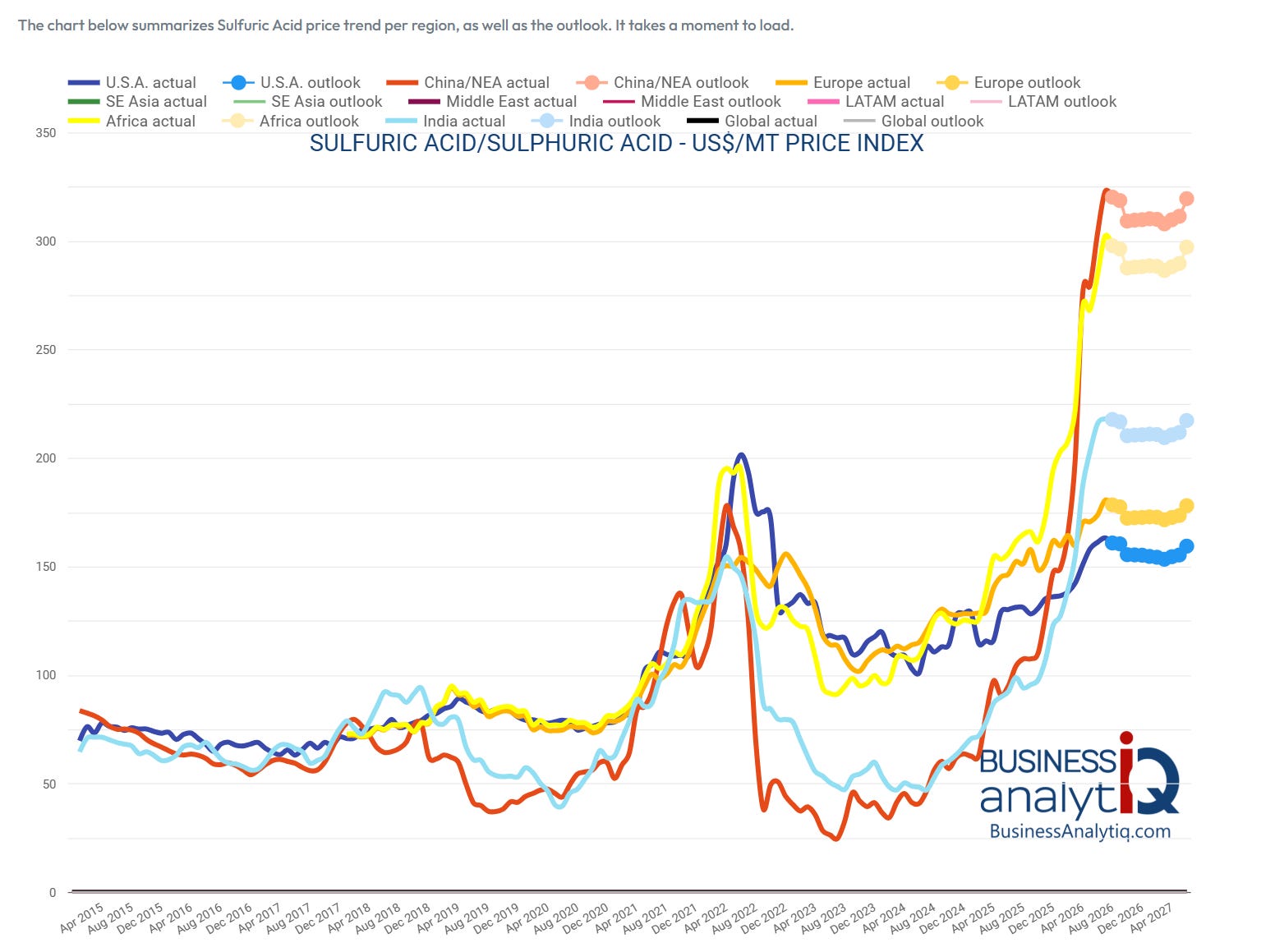
Sulfuric acid clears through a strict hierarchy of civilizational survival. Copper sits at the absolute back of this queue.
The reagent demands specialised vessels and rail tankers. Freight completely dominates the delivered cost, fracturing the supply into rigidly regional markets. Global auctions are an illusion; there is no integrated market. Diverting acid to a mine site requires a direct bidding war against phosphate plants in Brazil or India.
In 2026, spot acid prices exposed this geographic fracture, exceeding $165 a tonne in the United States, $380 in Indonesia, and $440 in Chile.
Four industrial sectors command sulfuric acid before a single drop reaches a copper leach pad:
I. The Defence Apparatus (Sovereign Force). Defence maintains absolute priority.
Nitrocellulose and related energetics require nitrating cellulose in mixed acid, relying on sulfuric acid as the dehydrating agent. Every propellant charge and shell filling demands this chemical reaction. While production volumes—such as Rheinmetall’s 1.1 million 155mm shells targeted for 2027—remain mathematically negligible against a 260 million-tonne acid market, the true threat is administrative precedence. By carving out acid for munitions, governments establish the exact machinery for state allocation. The defence sector claims the market structure, permanently ending commercial allocation.
II. Agriculture (Political Survival)
Agriculture commands the second position through sheer political protection. Phosphate fertiliser consumed roughly 140 million tonnes of sulfuric acid in 2025—the largest single global application. Agriculture lacks pricing power; at $440 a tonne, the acid inside a tonne of DAP consumes the majority of its selling price. Consequently, fertiliser production halts at price levels that copper extraction easily absorbs. When prices spiked in 2026, the state intervened. China halted sulfuric acid exports to protect domestic food security. Russia, Turkey, and the Democratic Republic of Congo executed parallel restrictions. State intervention actively controls the largest acid-exporting economies, completely independent of the copper transition.
III. Semiconductors and AI Compute (National Security)
Semiconductor fabrication holds the third position. Fabs consume small volumes of ultra-high purity acid, pay a 40% to 60% premium over industrial grades, and operate under strict national security mandates. Arizona’s semiconductor fabs now compete directly for the exact same regional acid as Arizona’s copper mines. AI data centres exist within this demand vector—they cannot be constructed without copper, and they do not run on intermittent wind power. AI and Semis are sneaking in above agriculture in priority because they are now one and the same to defence.
IV. The Energy Transition Cannibalising Itself.
The broader energy transition occupies the fourth slot. High-pressure acid leach (HPAL) for nickel, spodumene conversion for lithium, purified phosphoric acid for LFP cathodes, and high-purity manganese sulphate all demand massive volumes of sulfuric acid.
Over half of the 2026 global production for these critical battery inputs faces severe acid disruption. The battery supply chain and the copper supply chain are locked in a bidding war against each other for the identical reagent. The green transition literally cannibalises its own material inputs.
The Economics of Margin Destruction
Heap leach consumption spans 5 to 35 kilograms of acid per kilogram of copper.
At the low end of consumption, $440 acid injects $2,200 of reagent cost into a tonne of metal worth $13,000.
At the high end, the reagent cost reaches $15,400 for that exact same tonne.
The industry average margin offers zero protection against this math. The singular, destructive variable determining survival is the kilograms of acid required per kilogram of metal.
Standalone leach operations—which the industry desperately relies upon to process low-grade ore—fail first. Copper production is forced entirely into the hands of integrated sulphide producers that generate captive acid. Yet, these integrated majors fundamentally lack the capacity to grow.
VII. Different sovereign policies change supply chain assumptions
A copper mine is a twenty-year asset that survives only if capital is held securely across decades, generational and political regime changes. T
Chile. Codelco does not keep its profits. Chilean law routes the surplus to the treasury for pensions and roads, forcing the company to borrow to fund its own capital programme. Debt has ballooned into the high twenties of billions. Output has fallen. The company borrows to stabilise the very mines whose decline forced the borrowing. Stabilisation is not growth.
China. Beijing overbuilt smelting capacity as provincial employment policy, driving treatment charges to zero and spot below minus $100-170 a tonne. That margin compression travels back up the chain, gutting the economics of exploration in Zambia and defunding the Western juniors who find deposits. Whether this was an accident of keeping Gansu smelters running or a deliberate lock on global concentrate is irrelevant.
The result is the same though.
The West. In Arizona, Queensland or Sweden, permitting takes a decade, and building takes another five to seven years. Across that span, the presiding government changes three times. Equity markets price the political risk and force the allocation: deepen existing brownfield pits rather than finance greenfield discovery.
Alongside that, Western capital abandoned the material economy and lost a generation of process metallurgists, reagent chemists and tailings engineers. By treating extraction as an offshore environmental liability, the West walked into the externalisation trap and now imports strategic survival from the bloc it outsourced to. Modern economics didn’t really think through the sovereign consequences of an externalisation trap.
Three governments, all three are rivals and partners, with three unrelated objectives. All of them vie for who owns the final outcome.
VIII. The Sovereign Mask Drops
We operate under the assumption that the commercial market and defence are competing frameworks. In reality, they are, of course, always expressions of the same nation-state
When resources are abundant, the state delegates resource allocation to the commercial market. This allows capital to efficiently move materials, feeding the fatal miscalculation that financial capital automatically commands matter.
But when scarcity hits, when the copper residual drops below zero and the sulfuric acid supply dries up, the commercial market stops clearing.
Capital can’t buy what the Earth cannot physically supply in the window it needs it.
The moment the free market collapses under these physical constraints, the defence apparatus takes over.
This is not a hostile takeover or a disruption of the system; it is the system acting sanely. The free market is a luxury of material abundance, while sovereign allocation is the hard reality of material scarcity. History has seen this cycle many times, and it's no different now.
The state simply stops using price to dictate material flow and starts using legal and administrative force, such as the invocation of the Defense Production Act.
By pivoting from a commercial market to sovereign allocation, the state directly weaponises the supply chain. It secures its own munitions and physical infrastructure while simultaneously seizing the chokepoints that dictate the economic output of every allied nation downstream.
II. Compute as Munitions
The traditional definition of “defence” is obsolete. In a fractured multipolar system, the theatre of conflict has migrated from conventional ballistics to artificial intelligence and advanced silicon.
Data centres are the new dreadnoughts. Because compute is now synonymous with sovereign survival, artificial intelligence and semiconductor fabrication have been entirely absorbed into the defence apparatus.
They no longer operate as commercial tech enterprises; they operate as critical national security assets. This reclassification breaks the material demand queue. Folks breathlessly comparing the AI era to the dotcom era are comparing a home page with an oxygen mask. The motivations for keeping the dotcom madness alive weren’t existential as they are for all the major powers.
Previously, semiconductors and AI data centres sat behind munitions and agriculture, bidding for resources in a tightening commercial market. By classifying AI and silicon as defence infrastructure, the state elevates them to absolute priority.
The copper required to wire the 300-megawatt AI data centres and the ultra-high-purity sulfuric acid required to etch semiconductor wafers are no longer acquired through commercial pricing. They are secured through sovereign mandate. When tech hardware manufacturers or hyperscalers require the physical bill of materials to expand their compute capacity, they do not stand in line. The state ensures they receive the material because losing the AI arms race is viewed as an existential sovereign threat.
III. The Architecture of the Bloc
When the commercial market collapses under the weight of physical scarcity, the state is forced to secure the entire civilizational bloc. Sovereign allocation expands to command every tier of material existence:
The Total State: The illusion that the civilian economy operates independently of the defence apparatus shatters. Because you can't power a hypersonic manufacturing facility without a functioning grid, and you cannot maintain a workforce without fertiliser, the state must control the baseline inputs for everything. Agriculture, civilian infrastructure, and AI compute all fall under the jurisdiction of sovereign security.
The Master Allocator: In a fractured multipolar world, nations survive in allied blocs. The dominant state controlling the chokepoints, whether it is copper concentrate or sulfuric acid, becomes the master allocator for the entire bloc. It dictates the material flow to German industrial centres, Japanese semiconductor fabs, and Australian energy grids. At some point, an Australian copper mine might not be allowed to sell to a Chinese refiner. There is a vast raft of off-take agreements that were thought to be settled that may need to be resettled. It depends how serious the rivalry becomes.
The Subordination of Enterprise: Commercial output is no longer determined by consumer demand or quarterly profits; it is determined by the bloc's strategic survival. Every factory, data centre, and utility company effectively becomes a subordinate branch of sovereign state policy. If a specific tier of the allied economy does not serve the bloc's immediate survival, it is starved of the physical materials required to operate.
The dominant state uses material allocation to enforce discipline among its allies. The commercial free market is replaced by the Bloc Ledger. You receive the copper and the acid not because you can pay the highest price, but because your specific industrial output is a priority for the alliance's goals.
IV. The Execution of the Energy Transition
This expansion of the defence umbrella is the final execution order for the green energy transition.
The renewable grid was already starving, relying entirely on the “negative residual”—the leftover copper and acid after base industrial demand was met. Now, the transition is not just competing against housing and plumbing; it is competing directly against the military-industrial complex and the sovereign AI buildout for the exact same atoms, and both suddenly became much larger in demand.
The state will never sacrifice its AI supremacy or semiconductor independence to build a wind farm. The copper and the acid route directly into the defence-compute nexus, leaving the energy transition entirely devoid of the physical materials required to manifest its blueprints.
The financial ledgers will continue to fund decarbonization, but the Material Ledger has officially allocated the atoms to the sovereign defence of the bloc.
IX. What Price Can and Cannot Buy
Copper set records through 2026, touching $6.71 a pound intraday on COMEX in May. The price signal has fired.
Price moves cut-off grades, so existing pits yield more tonnes. It moves scrap collection rates. It moves substitution: aluminium already dominates overhead transmission, and it will keep taking share in busbars, motor windings and distribution wherever conductivity per dollar beats conductivity per volume. It moves brownfield expansion decisions.
Price doesn’t move a seventeen-year discovery-to-production interval. It doesn’t move a tailings permit through a seismic-zone approval. It doesn’t create sulphur that fossil refining no longer produces, because acid supply is set outside the copper market entirely.
Price buys tonnes from assets that already exist. The problem is arrival dates for assets that do not.
IIX. The Technology Answer, Measured
The industry’s best answer to the rate problem is leaching primary sulphides, chalcopyrite, which holds most of the world’s remaining copper and which resists conventional leaching. Rio Tinto’s Nuton, Jetti Resources, Ceibo and BHP’s own programme are all attacking it. The promise is real: cathode at the mine gate, no concentrator, no smelter, no China.
The volumes are the argument.
BHP, the best-capitalised operator in the industry, working the world’s largest copper mine, after years of trials with three competing technologies, estimates Escondida can produce as much as 55,000 tonnes a year by leaching. That is 4.5% of Escondida. Jetti is cheap to install and run and only slightly increases recoveries. Nuton’s first commercial copper came out of Johnson Camp in Arizona, a small restart, and its launch customer is Amazon Web Services, an offtake on first production, taken for data centre components.
A hyperscaler is vertically integrating into experimental hydrometallurgy to secure copper. SpaceX and xAI are planning vertical integration of metals as well. The constraint is real enough that the people who need the metal are no longer buying it. They are financing its extraction or refining.
And after a decade of development and billions in capital, the aggregate output of the technology that solves the rate problem is low single digits of the 1.8 million tonnes a year required.
X. The Draw Never Falls
Even if you phase the green energy transition over sixty years, it is the only condition under which secondary supply becomes viable, because copper returns at high rates from retiring turbines and wire.
But once the system is built, the annual draw never returns to its pre-transition level. It does not spike and subside. It steps up and stays there, set permanently by the replacement cycle. And the existing fossil system must be maintained throughout the build, so the world carries two infrastructure systems and pays the copper cost for both.
A constrained copper supply causes us to burn coal longer. New generation and grid don’t arrive on time, so existing thermal plants bypass their scheduled retirements.
Policy mandates a replacement grid. The metal is not there. Deployment slips. Load demand rises from AI. Thermal capacity is retained to fill the gap, and the retention is then read as evidence that the transition must move faster, spinning an aggressive loop of mandates against the same starved material base.
Watch the integrated resource plans in the United States, Germany, Japan and Korea. The retirement dates are already moving; you can already see it happening.
XI. The One Lever That Acts on the Rate
Almost every intervention targets the stock: explore more, permit faster, raise the price. One targets the rate, by deleting the seventeen-year delay outright.
Legacy industrial waste, tailings, slag, red mud, and electronic scrap carry no exploration lead time.
The deposit is delineated and sits on the surface, with assay records going back decades. The permitting path is drastically shorter because the ground is already disturbed and the liability already exists; in most jurisdictions, remediation is a legal obligation rather than a new impact. There is no pit, no strip ratio, no waste dump, and no new tailings facility; the tailings facility is the orebody.
This converts a geology problem into a chemistry problem, and chemistry problems resolve in three to five years rather than seventeen.
The grades are not trivial. Historic Chilean and Arizonan tailings carry 0.1% to 0.3% copper, deposited by recovery circuits that were poor by modern standards, alongside molybdenum, cobalt and rare earths that were never targeted. Escondida’s own waste dumps have been leached for decades, which proves the route works at scale on disturbed ground.
It will not close the gap. It is the only intervention capable of changing the physical arrival date of new metal inside this decade. And no Western jurisdiction currently operates commercial-scale copper recovery from legacy tailings at a volume that registers in national statistics.
XII. When the Choke Point Moves
Today the choke point sits at refining, and China holds it. As the deficit deepens, the bottleneck migrates upstream from the smelter to the mine gate. When concentrate becomes scarce, the commercial market stops clearing, and allocation becomes a function of the state.
This phase is already active policy.
In July 2026, the United States invoked the Defence Production Act to institute export restrictions on recoverable critical minerals and materials. The state recognised the physical deficit and established absolute capital controls over physical matter. The commercial market no longer dictates where materials flow; sovereign necessity dictates it.
The primary actor securing these supply chains is no longer the environmental lobby. It is the defence apparatus. The Department of War is directly capitalising the extraction of refractory-grade bauxite, scandium for high-heat aluminium alloys, and silicon-carbon battery anodes. The justification is munitions, fighter jets, and the defence industrial base. The material requirements of the energy transition are now entirely subordinate to military procurement.
The administration is simultaneously attempting to reverse the Externalisation Trap. The Department of Energy and the Department of War allocated $180 million to revitalise American mining schools and train the next generation of metallurgists and geologists. The state acknowledges the structural deficit in sovereign human capital. Yet human capital carries a rigid lead time. A freshman funded in 2026 enters the commercial workforce in 2030, and manages a capital project in 2040.
The scale of the state intervention exposes the severity of the deficit. The administration deployed $2 billion across the domestic mining sector. That figure represents a historic political mobilisation, yet falls a billion dollars short of the capital required to build a single tier-one copper mine.
That isn’t a criticism; it’s just a reflection of reality.
The government recognises the material ledger, but the financial allocations remain detached from the physical reality of extraction.
The commercial market for strategic materials is closed. We operate in an era of hard bifurcation, where states weaponise export controls and directly capitalise extraction to guarantee sovereign survival.
XIII. Wrong in Architecture, Not Behind Schedule
The energy transition receives no dedicated copper supply, so the planet has no climate exit strategy.
The transition receives what remains after incumbent demand, and that residual is already below zero, so it has no way of moving forward.
This is the real problem with Chinese overcapacity in solar, EV, wind, etc. It’s not that the Chinese will outcompete the West in the production of renewable energy (which they will); it is that the mining supply chain was never adequate to feed that production ambition in the first place, nor has the consumption demand ever been qualified as adequate.
The assumed prize for winning the renewable production race may not be the treasure it was imagined to be.
An unfeedable design doesn’t become feasible by stretching it over sixty years; accelerating it only brings the collision forward. A plan that must maintain one energy system while building a second, more copper-intensive one is not behind schedule. It is wrong in architecture.
If this is really our roadmap to escape climate change, then we are on a brutal roller coaster because this map won’t avoid any climate consequences.
After a quick superficial scan of this massive, heavily researched report, I come to one unpleasant conclusion.
Because we have allowed our population to soar unmanageably, we are rapidly running out of raw materials without which our industrial civilisation breaks down. To alleviate that problem - for a while, as much as possible - governments are already making deep inroads into civil liberties, and may soon transform supposedly "free" societies into heavily controlled military camps.
Thanks Craig - excellent article. Does it seem like we need to pull a global order together? Immediately work ‘as one world’ and put the brakes on everything that copper is part of, like the military equipment, and put the brakes on the technology competition?
If copper is finite, we save the planet first.